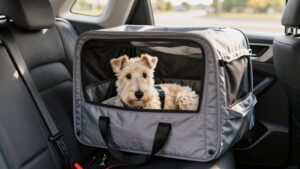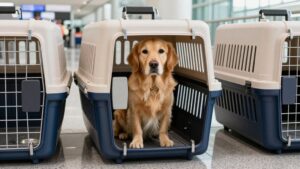
In-Cabin Pet Carrier Size Limits by Airline (Under-Seat Dimensions)
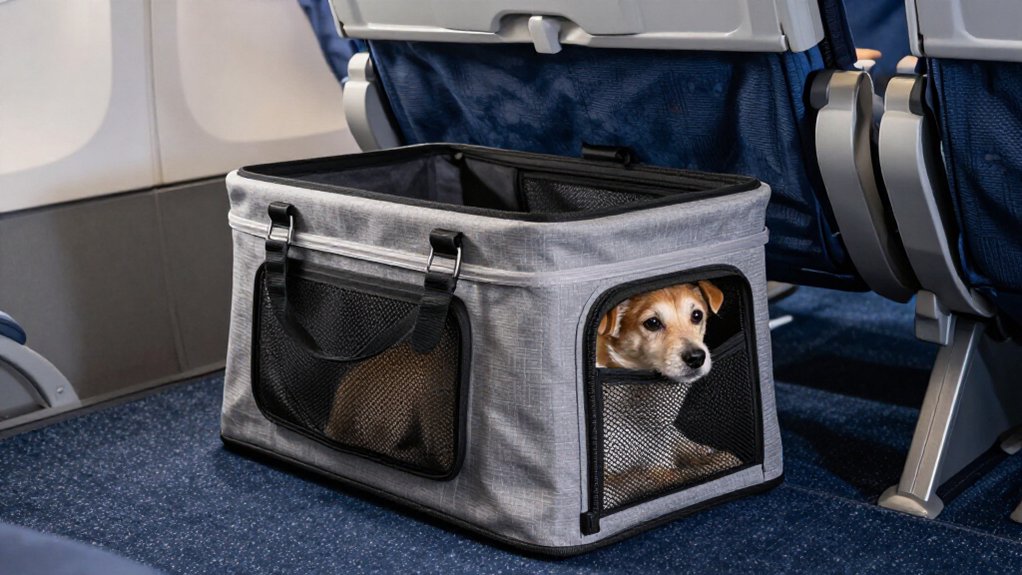
For in-cabin travel, match your carrier to each airline’s current limit and your assigned seat’s under-seat space.
Alaska allows soft-sided carriers up to 17 × 11 × 9.5 inches; JetBlue allows 17 × 12.5 × 8.5 inches. American and United set different limits for hard- and soft-sided carriers.
Measure the carrier’s widest exterior points, including handles, and check every flight segment. Your pet must stand, turn, and lie comfortably.
Reserve limited pet space early; the details below can help you check close fits.
2026 Airline Dimension Updates
As you plan for 2026, check each airline’s current pet-carrier rules because under-seat space and size limits can vary by aircraft, route, and cabin.
American, Delta, and United publish soft-sided carrier guidance, while Alaska, JetBlue, and Southwest set allowances. United and American distinguish hard-sided carriers from soft-sided ones, so check the rules for the carrier you’ll bring. European policies differ as well: airlines’ allowances range from more restrictive options to those offered by Lufthansa, Swiss, and Air Baltic.
Before booking, confirm the policy for your route, aircraft, cabin, and pet type, then verify whether your carrier must fit beneath the seat. If you’re connecting or changing airlines, check every operating carrier’s requirements; the most permissive segment won’t override a stricter one. Recheck before departure; rules can change.
Airline-by-Airline Dimensions
Here are the published in-cabin carrier limits for five U.S. airlines: Alaska requires a soft-sided carrier no larger than 17 × 11 × 9.5 inches; American allows soft-sided carriers up to 18 × 11 × 11 inches, with different hard-sided limits for mainline and American Eagle aircraft. Use the limit for your exact airline and aircraft: American’s hard-sided maximum is 19 × 13 × 9 inches on mainline flights and 16 × 12 × 8 inches on American Eagle.
| Airline | Published limit |
|---|---|
| Delta / JetBlue | Delta: approximately 18 × 11 × 11 inches; JetBlue: 17 × 12.5 × 8.5 inches |
| Southwest | 18.5 × 13.5 × 9.5 inches; your carrier must fit completely under the seat |
Check your carrier’s measurements against the applicable limit before booking. Delta notes that its approximate size fits most aircraft, but space varies. For Alaska, choose a soft-sided carrier; don’t assume American’s soft-sided allowance applies to hard-sided models. Confirm your aircraft-specific requirements with the airline before travel.
Under-Seat Clearance Terms
Under-seat fit means your carrier must sit completely beneath the seat in front of you during takeoff and landing. Airlines set different maximum dimensions: JetBlue lists 17 × 12.5 × 8.5 inches, while Southwest allows up to 18.5 × 13.5 × 9.5 inches. Aircraft-specific clearance still matters: space can vary by aircraft, cabin, and seat, so a carrier within an airline’s published limit may not fit your particular flight.
Soft-sided carriers may compress slightly, but they can’t require excessive pressure to fit beneath the seat. Check seat restrictions too: exit-row and bulkhead seats may lack usable under-seat space or may not allow pets.
Before choosing your seat, confirm the airline’s rules for your route and aircraft; published dimensions don’t guarantee clearance on every flight. Confirm your assigned seat’s under-seat space in advance.
Carrier Dimension Measurement Method
Measure your carrier’s exterior length, width, and height, including wheels, handles, and other protrusions. Compare each dimension with your airline’s published limits and check its rules for measuring soft-sided carriers. Confirm the carrier fits beneath the seat on your specific aircraft without excessive compression.
Measure Carrier Length
To check whether your carrier meets an airline’s length limit, measure it from front edge to back edge in its normal travel shape.
Compare that measurement with the airline’s stated maximum length. Alaska Airlines and JetBlue allow up to 17 inches, while American Airlines allows up to 18 inches for soft-sided carriers. Check your specific aircraft and carrier type before booking; American’s hard-sided limit is 19 inches on mainline flights, but regional aircraft may have smaller limits.
Measure the carrier itself, not your pet’s length. Your pet must still be able to stand, turn around, and lie down comfortably inside. For a soft-sided carrier, record its full length before compression, then confirm it fits beneath the seat without excessive compression. Check rules first.
Measure Carrier Width
Check the carrier’s width at its broadest point, from outer edge to outer edge, including fabric, seams, and pockets. Measure a soft-sided carrier when it’s packed as you plan to travel; contents can change its shape and increase its width. Compare it with the airline’s stated limit. Alaska, American, Delta, and United each list an 11-inch width limit, while JetBlue allows 12.5 inches.
Check the aircraft’s under-seat space too: published dimensions don’t guarantee the same fit on every flight. Before booking or departure, verify the carrier can fit in the cabin space. Don’t assume you can squeeze an oversized carrier into place; it must fit beneath the seat without excessive compression. If its width exceeds the limit or aircraft’s available space, choose a narrower model.
Measure Carrier Height
Height can be as limiting as width, so measure from the carrier’s base to its highest point, including handles and other parts that could affect under-seat fit.
Compare the measurement with your airline’s published limit: Alaska allows 9.5 inches, JetBlue 8.5 inches, and American’s soft-sided limit is 11 inches. Check the aircraft-specific space too; a listed maximum doesn’t guarantee that the carrier will fit beneath the seat on every flight segment.
Measure a soft-sided carrier in its normal packed shape. It may compress slightly but must fit without excessive pressure or forcing. Recheck its height after adding a pad or bedding because these can make the carrier taller or change how it sits beneath the seat. Confirm the aircraft and seat for every segment before departure.
Include Wheels and Handles
When measuring your carrier, include its full exterior length, width, and height, including wheels, handles, and other protruding parts. Measure from the outermost points, not just the fabric body or rigid shell. A raised handle, wheel housing, or side pocket can push a carrier beyond an airline’s published allowance.
For example, Alaska’s maximum is 17 × 11 × 9.5 inches; JetBlue’s is 17 × 12.5 × 8.5 inches. Compare each measurement with the applicable limit, and don’t treat wheels or handles as exempt. Staff may assess the carrier as you present it at check-in.
If you use a soft-sided carrier, slight compression may be allowed, but it must slide under the seat without excessive force. Check each aircraft’s under-seat fit; space can also vary.
Check Airline Measuring Rules
Before booking, compare your carrier’s exterior length, width, and height, including wheels, handles, and other protrusions, with the airline’s limits.
Measure in its normal travel configuration, then check each dimension against the carrier rules for your flight. Some airlines set separate limits for soft-sided and hard-sided carriers. American Airlines permits soft carriers up to 18 × 11 × 11 inches, but hard-carrier limits vary by aircraft. Don’t assume a soft-sided carrier can be squeezed into any space; it must fit under the seat without excessive compression.
Check your specific aircraft’s under-seat space because dimensions can vary by aircraft and route, and the carrier must remain beneath the seat throughout the flight. Don’t rely on a general 18 × 11 × 11-inch guideline: Alaska lists 17 × 11 × 9.5 inches, while JetBlue lists 17 × 12.5 × 8.5 inches. Confirm the limit with your airline.
Cabin-Class Carrier Rules
Your in-cabin carrier must fit completely under the seat in front of you, and available space varies by aircraft and cabin.
American allows soft-sided carriers up to 18×11×11 inches; its hard-sided limit is 19×13×9 inches on mainline aircraft, but drops to 16×12×8 inches on American Eagle. Alaska’s cabin limit is 17×11×9.5 inches, while JetBlue allows 17×12.5×8.5 inches. Southwest accepts carriers up to 18.5×13.5×9.5 inches; United lists a soft-sided maximum of 18×11×11 inches.
American doesn’t permit carry-on pets in bulkhead or exit-row seats. Some aircraft and premium cabins impose additional restrictions, so check your itinerary’s cabin and aircraft before choosing a carrier. Use the smallest applicable limit, and confirm whether your specific seat can accommodate the carrier before you book your next flight online.
Ventilation and Pet-Fit Limits
A carrier that meets your airline’s size limit still needs to let your pet stand, turn around, and lie down comfortably.
For American Airlines, choose a secure, padded, water-repellent soft-sided carrier with nylon-mesh ventilation on at least three sides. Check your airline’s rules before booking; Air Canada recommends ventilation on multiple sides. Measure your pet while standing: record the height from the floor to the top of the head or ears, then measure length from nose to the base of the tail.
Soft-sided carriers can compress slightly, but don’t squeeze yours so tightly that your pet can’t move comfortably inside. Confirm your pet can change position after you zip the carrier; airline acceptance doesn’t replace this comfort check, even when the carrier meets dimensions.
Tall Carrier Under Seats
Tall carriers may not fit under the seat: height limits range from about 8.5 inches on JetBlue to 11 inches on American, Delta, and United.
Your carrier’s listed height is only a starting point because aircraft layouts can change usable space. Alaska’s typical maximum is 9.5 inches. Southwest’s limit appears as either 9.5 or 8.5 inches across guides, so check the rule for your flight and aircraft.
Measure your carrier and confirm it fits fully beneath the seat without excessive compression. A soft-sided model may compress slightly, but don’t squeeze it so much that your pet can’t stand, turn around, and lie down comfortably. On American, avoid bulkhead and exit-row seats: you can’t place the carrier under those seats, or may be no room.
Booking Pet Space Early
Even if your carrier fits beneath the seat, your pet still needs a limited in-cabin spot, so reserve space as early as possible. Because most airlines cap pets per flight, an acceptable carrier doesn’t guarantee availability. Confirm your pet’s reservation directly with the airline before you book travel; rules and space can vary by airline, aircraft, and cabin.
- On American, add your carry-on pet on the website or app under Additional Services, then select flights and confirm the reservation.
- Check seat restrictions before choosing: American bars pets from bulkhead and exit rows; some premium-cabin seats also have limits.
- Recheck current policy before departure; a full pet allowance can prevent travel even when your carrier size is approved. Don’t assume approval means space remains available.
Airline Dimension Source Dates
Because airline carrier limits can change, check each airline’s official pet policy before booking and again before travel. Use the policy page’s current wording, and note when you checked it; don’t rely on an undated online chart.
- American Airlines lists soft-sided carriers at 18×11×11 inches and hard-sided carriers at 19×13×9 inches on mainline aircraft; regional aircraft may allow less.
- United’s stated limits are 18×11×11 inches for soft-sided carriers and 17.5×12×7.5 inches for hard-sided carriers.
- Southwest’s maximum is 18.5×13.5×9.5 inches; JetBlue’s is 17×12.5×8.5 inches.
- Before you fly, match the policy to your specific itinerary and route: aircraft and under-seat space vary, so published dimensions don’t guarantee a fit.
If your carrier is close to the limit, contact the airline about your aircraft and confirm acceptance at check-in before departure.
Conclusion
Before you book, compare your carrier’s measured length, width, and height with your airline’s current under-seat limit—not a chart. Check the aircraft and cabin class, since seat clearance can change by route and configuration. Confirm soft-sided carrier rules, ventilation, and your pet’s ability to stand and turn. Then reserve pet space early and recheck the airline’s dated policy before departure. If your carrier won’t fit, choose another approved option; don’t rely on squeezing it in.