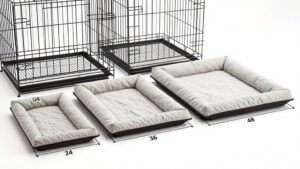
Are Dog Crate Trays Universal? Brand Fit and Sizing Explained
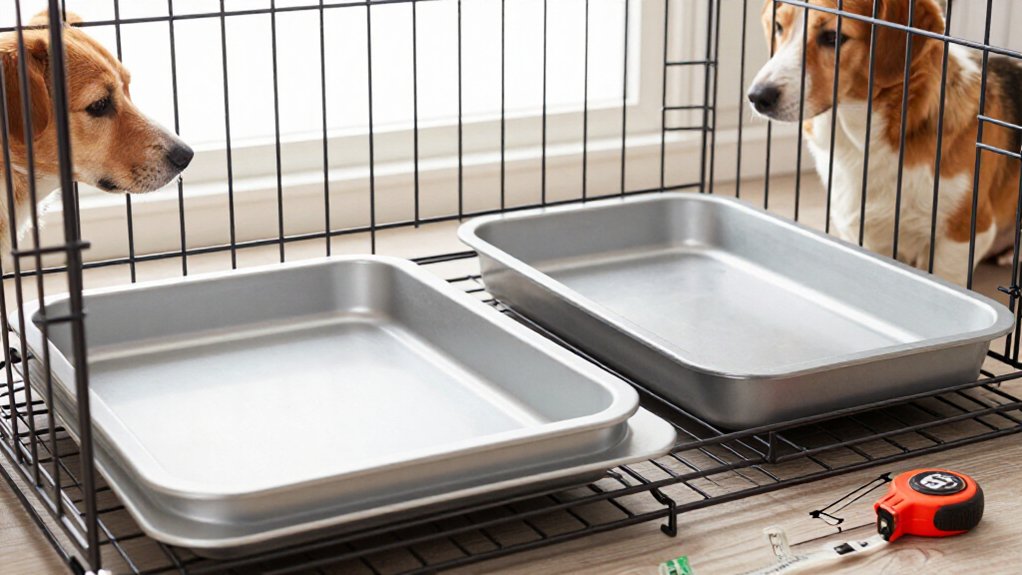
No, dog crate trays aren’t universal: matching advertised sizes don’t guarantee a fit. Check your crate’s brand and model, then measure the interior floor at floor level, inside wall to inside wall, not the exterior label or wire spacing.
Compare the tray’s length, width, and lip depth with available rail clearance; measure both ends if the frame tapers. You can measure without removing the pan.
Below, you’ll find material and custom-fit details for your crate.
Crate Brand and Tray Fit
Dog crate trays aren’t universally interchangeable: interior floor dimensions vary by brand and model, even among crates sold as the same size. Before ordering, measure your crate’s interior floor length and width; don’t rely on its brand name or a tray listing alone. A 47.0 × 29.1 × 1.0-inch replacement pan fits most standard 47-inch wire crates, but check your specific model’s floor dimensions first.
That check helps you avoid a tray that’s too long, too narrow, or unable to sit flat. When requesting a custom tray, provide the crate’s brand and model along with your carefully checked measurements. MidWest, Frisco, You & Me, and Precision Pet are popular brands you can identify when contacting a maker. Custom pans follow submitted dimensions, so verify measurements before ordering.
Why Nominal Sizes Mislead
A crate labeled “47-inch” usually refers to its outside size, not the tray’s interior floor, so a pan that fits one model may not fit another. Measure your crate’s interior floor length and width before ordering; advertised dimensions won’t tell you the pan footprint. The Pinnacle Systems pan measures 47.0 × 29.1 inches, but that doesn’t make it a match for every nominally 47-inch crate.
| Label | What it tells you |
|---|---|
| 47-inch | Outside crate size |
| Interior floor | Measure length × width |
| Replacement pan | Compare dimensions and fit |
Also confirm tray height and slide-in fit; length and width alone can’t guarantee compatibility. For a custom order, send exact measurements and, if you have them, the crate’s brand and model. Treat the label as a starting point, not a sizing specification.
Checking Tray Lip Depth
Even when the length and width match, the tray’s lip must clear the crate frame so the pan can slide in. Check lip depth against the opening’s actual clearance, not just the floor area. The Pinnacle Systems replacement tray has a 1-inch lip height; compare that figure with your crate’s clearance and pan design before ordering.
Don’t rely on a listed crate length, such as 47 inches, because it usually describes the outside. Measure the usable tray space inside instead. Brand and model names don’t guarantee matching interior dimensions or lip clearance. If your crate has an unusual frame or the lip depth isn’t clear, confirm the tray measurements with the manufacturer. Check all sides, since frame details may vary around the opening.
Replacement Pans by Material
Plastic pans can crack, warp, stain, or hold odors, so check whether a galvanized steel replacement better suits your daily use. Galvanized steel resists rust and chewing, while T304 stainless steel offers greater corrosion resistance for frequent use or stricter sanitation. Before you choose, measure your crate’s interior floor and match the pan’s dimensions.
Plastic Replacement Pans
If your plastic crate pan is cracked, warped, or chewed, a galvanized metal replacement offers a durable, easy-to-clean alternative. Your next priority is fit, not the crate’s advertised length. Two wire crates labeled 47-inch can have different interior floor dimensions, so a pan that fits one may not seat properly in the other. Measure the interior floor length and width, then compare both with the replacement pan dimensions before ordering.
| Check | What you need | Why it matters |
|---|---|---|
| Floor length | Interior measurement | Brands differ |
| Floor width | Interior measurement | Prevents mismatch |
Pinnacle Systems’ 47 × 29.1 × 1-inch pan is designed for most standard 47-inch wire crates, but confirm your model’s fit. For a custom tray, send interior measurements and your crate’s brand or model, if known, too.
Galvanized Steel Pans
For a tougher replacement, galvanized steel resists rust and corrosion while standing up to routine cleanup after accidents. Choose this material when a plastic tray has cracked, warped, picked up chew damage, or retained odors. PortaTray’s galvanized option uses 22-gauge G90 steel, giving you a pan with a moisture-resistant finish.
Before ordering a replacement, compare its length, width, and depth with your crate’s interior—not the crate size alone. Pinnacle Systems’ pan measures 47 × 29.1 × 1 inches and fits standard 47-inch wire crates, but confirm interior measurements first. If your crate has non-standard dimensions, you can order a custom galvanized pan. Measure carefully before submitting: custom trays aren’t returnable. The metal surface handles cleanup, and its finish helps resist moisture and odors.
Stainless Steel Pans
Stainless steel offers a durable alternative to galvanized steel, with strong corrosion resistance and a smooth surface that’s easy to clean. PortaTray’s 24-gauge T304 steel pan, for example, adds a 2B finish that wipes clean readily. Choose stainless when your crate sees frequent use or sanitation matters, such as in veterinary clinics, grooming facilities, or professional kennels.
Before ordering, measure the interior floor length and width; advertised crate dimensions may not match usable floor space. Stainless steel can replace cracked, warped, or hard-to-find plastic trays, but confirm the exact pan dimensions and fit. Custom pans can suit older models, non-standard crates, and kennel runs; verify every measurement carefully, because custom trays aren’t returnable.
Check fit before you commit to a made-to-order replacement pan order.
Tray Lip Depth
Measure the tray’s lip, the raised edge, and compare it with your crate’s rails and available clearance so the pan slides in and sits properly. The Pinnacle Systems replacement tray has a 1-inch lip, but don’t assume that depth fits your crate. Measure the interior tray space, including edge clearance, and verify your specific model’s dimensions before ordering.
Measure the Lip Depth
A tray’s height matters as much as its length and width: check the raised lip’s depth to confirm it clears the crate frame, especially where the pan slides beneath the wire sides.
Measure the lip vertically from the tray’s bottom surface to the top of its raised edge; don’t rely on the tray height alone. Even when floor dimensions match, a tall lip can catch before the pan seats fully.
Check available clearance at the crate frame, particularly beneath the wire sides, then compare your measurement with the original pan or the manufacturer’s specifications. The Pinnacle Systems MWCRATES tray is listed as 1.0 inch high, but verify that this lip height suits your crate’s clearance before ordering. For custom orders, give lip depth too.
Match the Crate Rails
Even when a tray matches your crate’s interior floor dimensions, its lip must clear the rails and sit securely against them. Measure the opening beneath the rails, then compare that clearance with the tray’s lip depth. If the lip is too deep, you won’t be able to slide the tray into place; if it’s too shallow, the tray may sit loosely.
Check the crate itself rather than relying on its advertised size: “47-inch” usually describes the exterior, and rail spacing varies by brand and model. For the Pinnacle Systems MWCRATES pan, confirm the rail opening can accommodate its 47.0 × 29.1-inch footprint and 1.0-inch height. Ordering a custom tray? Measure your specific crate’s rail layout carefully, because the maker builds to the dimensions you submit.
Check Clearance and Fit
Once the rails line up, check the tray’s lip depth as well as its length and width. Measure your crate’s interior floor, because a “47-inch” label usually describes the outside and may not match the tray. Compare the tray’s full footprint and lip height with the available clearance; a tall or wide edge can catch on the frame or stop the pan from sliding in. For example, the Pinnacle Systems replacement tray measures 47.0 × 29.1 inches and has a one-inch lip.
Before ordering, verify the exact crate brand and model, since interior sizes and clearances vary even among crates with the same advertised size. If you’re ordering a custom tray, recheck every measurement before submitting precisely.
Measuring a Tray’s Interior Width
To check whether a replacement tray will fit, measure the crate’s interior floor from side to side where the tray rests—not its advertised outside width. Measure at the bottom, where the tray sits; interior dimensions can vary by brand and model, even when crate labels suggest similar sizing. Use a tape measure, keep it level across the floor, and take the measurement more than once. Record the result in inches so you can compare it accurately and reduce ordering errors.
Then check the replacement tray’s listed width against your measurement, allowing for a close, practical fit rather than relying on the crate’s nominal size. For reference, the Pinnacle Systems MWCRATES pan measures 29.1 inches wide. If your crate has an unusual shape or size, provide its interior measurements and brand or model when requesting a custom tray. This helps the supplier make a tray suited to your crate accurately.
Bent or Corroded Trays
If your crate tray is bent, cracked, or corroded, replace it when it no longer sits flat or cleans up easily—a damaged pan can feel uncomfortable for your dog and be harder to keep sanitary.
For everyday use, galvanized steel resists rust and moisture. A replacement pan can handle scratching and daily wear, and it offers a chew-resistant, crack-proof alternative if your dog has damaged a plastic tray. In a high-use crate, 24-gauge T304 stainless steel provides stronger corrosion resistance.
Check the replacement’s compatibility with your specific crate brand and model; advertised crate size alone doesn’t guarantee a matching pan. Choose a tray that rests securely without rocking. A durable replacement makes cleanup simpler and gives your dog a stable surface.
Measuring Without Removing the Pan
You can measure the crate floor without removing the pan: at floor level, measure between the inside walls, not the wire bars or rounded corners, and take the length and width at both ends. A “47-inch” crate label gives its outside size, not the usable pan area. Check both ends; a tapered frame can narrow the floor. Use the smallest usable length and width when shopping.
- Keep your tape measure level with the pan surface.
- Measure from inside wall to inside wall.
- Avoid bars and curved corner space.
- Compare your figures with listed replacement pan dimensions.
- Check custom measurements carefully; submitted sizes may be non-returnable.
Record your readings, then recheck them carefully against the replacement pan’s listed dimensions before ordering.
Match the Crate’s Brand and Model
Even when two crates share the same advertised length, their floor dimensions can differ by brand and model, so a tray that fits one 47-inch crate may not fit another. Check your crate’s brand and model—MidWest, Frisco, You & Me, or Precision Pet—then measure the interior floor length and width before ordering. A listing for a 47-inch wire crate doesn’t guarantee compatibility; compare its stated dimensions with your measurements.
| Brand/model | Measure | Action |
|---|---|---|
| MidWest / Frisco | Length and width | Verify listed size |
| You & Me / Precision Pet | Floor dimensions | Match dimensions |
| Custom | PortaTray details | Confirm specifications |
For a replacement, send PortaTray your measurements and, when known, the crate’s brand and model. Custom trays follow submitted specifications and can’t be returned, so recheck fit details before purchase.
Conclusion
Dog crate trays aren’t truly universal, so don’t rely on a size label alone. Measure your existing pan’s interior width, length, and lip depth, then compare those figures with the crate’s brand and model. Check material and condition, too: a bent or corroded tray may need replacement, not a closer fit.
If you can’t remove the pan, measure carefully in place. Checks help you choose a tray that slides in securely and stays put.