How Big Should an Outdoor Dog Kennel Be? Size Chart by Dog Weight
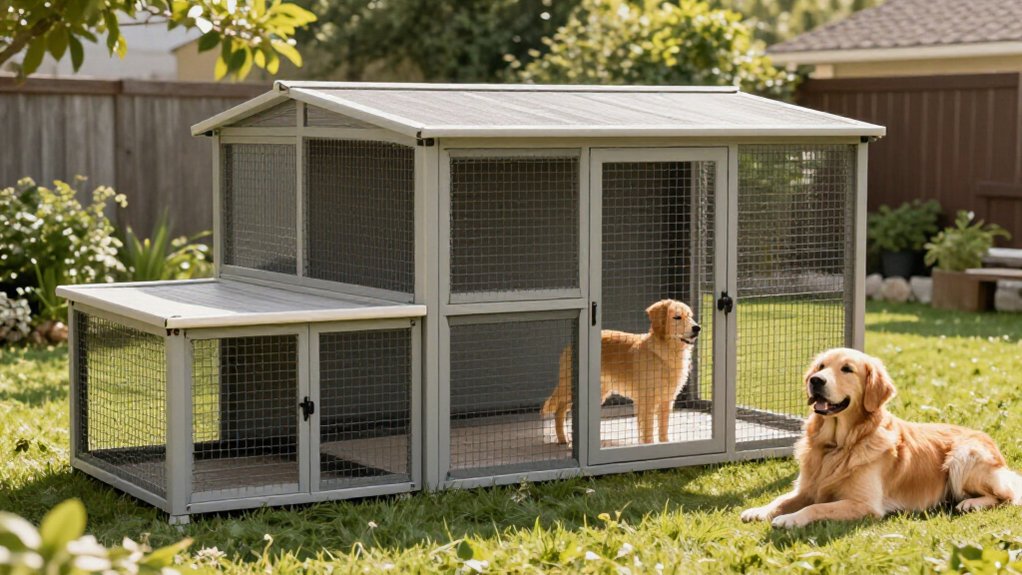
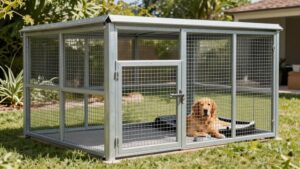
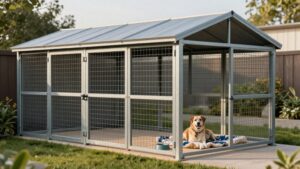
Use weight as a guide: small kennels suit dogs weighing 5–15 lb, medium 15–25 lb, large 25–65 lb, XL 65–85 lb, and XXL 85–150 lb. Bands overlap, and labels don’t confirm fit.
Measure your dog’s nose-to-tail-base length, shoulder width, and standing height, then compare them with interior dimensions.
Your dog must stand, turn, and lie down without restriction. Choose a larger kennel when measurements require it.
Use the guidance below to refine your plan safely.
Outdoor Kennel Sizes by Weight
Weight charts offer a starting point: small dogs (5–15 lb) often suit small kennels, medium dogs (15–25 lb) medium kennels, and large dogs (25–65 lb) large kennels; extra-large and XXL kennels commonly suit dogs weighing 65–85 lb and 85–150 lb, respectively.
Treat these categories as guidance, not a final fit decision. Dogs at the same weight can differ in height and length, so weight alone can’t confirm adequate space. Before buying, compare your dog’s measurements with the kennel’s interior dimensions.
Check that your dog can stand naturally, turn around, and lie down without restriction. If your dog falls between categories, choose a kennel that accommodates its larger space requirement; don’t rely on weight or breed labels alone for safe, comfortable daily movement and rest.
Outdoor Kennel Size Chart
A size chart can narrow your options, but your dog’s measurements and intended use should guide the final choice.
| Weight range | Kennel category | Guidance |
|---|---|---|
| 5–15 lb | Small | Starting range |
| 15–25 lb | Medium | Starting range |
| 25–150 lb | Large to XXL | See bands below |
Large suits 25–65 lb dogs, XL 65–85 lb, and XXL 85–150 lb. Treat ranges as starting points: breed and body shape affect space needs.
For one medium-to-large dog, a 6 × 12 ft run is practical; 8 × 12 ft allows more room for several hours’ daily use. Active or working dogs benefit from longer 5 × 15 ft or 6 × 20 ft runs. For two compatible dogs, size for the larger dog and add 50–100% more space for the second. Don’t choose by weight alone; provide secure containment and room for safe movement.
Measuring Kennel Floor Space
To estimate usable kennel floor space, measure your dog from nose to tail base and across the shoulders, then plan for clear movement beyond those dimensions. For a medium-to-large dog, 6 × 12 feet offers a practical home-run starting point; choose about 8 × 12 feet if your dog spends several hours there daily. Active dogs benefit from a long layout, such as 5 × 15 or 6 × 20 feet, which supports trotting better than a square run of similar area.
Count only unobstructed activity space: shelter boxes, platforms, bowls, and feeders reduce usable floor area. A 24-inch-deep platform in a 4-foot-wide run occupies half its width. If two compatible dogs share the kennel, size for the larger dog and add 50–100% more area, though separate runs are generally often safer.
Breed-Specific Weight Variations
Breed weight ranges can differ by sex and lineage, but they’re only rough guides because individual dogs vary in build. Don’t use weight-based crate categories as outdoor-run dimensions; measure your dog, including shoulder width, to confirm safe fit. If your dog’s under 18 months, allow for adult growth, and size a shared run to the larger dog’s needs plus 50–100% more space for the second dog.
Typical Weight Ranges
Although weight charts offer a useful starting point, dogs of the same breed can vary considerably, so measure your dog before selecting an outdoor kennel.
Crate-size charts place small dogs (5–15 lb), medium dogs (15–25 lb), large dogs (25–65 lb), XL dogs (65–85 lb), and XXL dogs (85–150 lb). Kennel labels may instead define large as 50–70 lb, extra-large as 70–90 lb, and XXL as over 90 lb, so ranges overlap. Treat these categories as screening guides, not fixed dimensions. Your dog’s height, length, and shoulder width determine whether the enclosure allows standing, turning, and lying down.
Measure your dog and compare those dimensions with the kennel’s interior space. For dogs younger than 18 months, consider projected adult weight and measurements; current size alone may lead you to choose a kennel they’ll outgrow.
Males Versus Females
Sex can affect a dog’s expected size, but it shouldn’t determine kennel dimensions. Male dogs are heavier and larger than females of the same breed, so treat weight-based charts as starting points, not substitutes for measuring your dog. For example, male German Shepherds weigh about 65–90 lb, while females weigh about 50–70 lb; they may fall into different chart ranges.
Measure your dog’s height, nose-to-tail-base length, and shoulder width, then select a kennel that fits its dimensions and activity needs. If its weight falls between categories, use those measurements and choose the larger kennel rather than sizing by sex or breed label alone. For two dogs of different sexes or sizes sharing a run, plan for the larger dog and provide extra space.
Breed Line Differences
A breed’s listed weight range is only a rough guide because dogs of the same breed can differ in height, length, and build. Breed lines also affect kennel needs. Barrel-chested breeds, such as Bulldogs and Mastiffs, may need extra width compared with dogs of equal weight but narrower frames.
Working lines of herding, hunting, detection, or protection breeds often have greater activity needs than companion lines of similar weight. For these dogs, choose a larger, longer run to support safe movement and exercise; don’t rely on weight alone. Measure your dog from nose to tail base and from the floor to the highest point of the head or ears, then check those dimensions against the kennel’s usable space. If your dog is under 18 months, size for projected adult measurements, not current weight alone.
Individual Build Variations
Even within the same breed, dogs can vary considerably in height, length, and build, so weight charts are only a starting point.
Measure your dog from nose to tail base, from the floor to the top of the head or ear tips, and across the widest point, usually the shoulders. Use measurements to assess individual fit. For example, a broad-chested Bulldog or Mastiff may need greater kennel width than a similarly weighted, narrower dog.
If your dog is under 18 months, account for projected adult size; a kennel that fits now may soon restrict movement. When your dog falls between chart categories, compare its measurements with the listed dimensions and choose the larger option if needed for comfortable movement. Recheck fit as your dog grows.
Weight-Based Sizing Limits
Because individual dogs within the same breed can vary in weight and build, use the chart’s ranges only as a starting point: small, 5–15 lb; medium, 15–25 lb; large, 25–65 lb; XL, 65–85 lb; and XXL, 85–150 lb.
Measure your dog’s height and nose-to-tail-base length before choosing a kennel. Breed-specific averages can’t predict an individual’s dimensions or whether its frame is compact or broad. If your dog’s weight falls near a range boundary, choose the larger option when measurements or broad shoulders require space. Don’t size a puppy by current weight alone; consider expected adult size to reduce the risk of outgrowing the enclosure.
Before use, confirm your dog can stand naturally, turn around, and lie stretched out comfortably. Weight alone can’t establish fit.
Turning Weight Into Kennel Dimensions
Use weight only as a starting point: typical crate-chart ranges are 5–15 lb for small dogs, 15–25 lb for medium, 25–65 lb for large, 65–85 lb for XL, and 85–150 lb for XXL, but these labels don’t determine outdoor-run dimensions. You should measure your dog and verify the kennel’s interior dimensions; weight alone can’t show whether your dog can stand, turn, and lie down. For a large dog, use 6 × 10 ft as a starting point; choose about 8 × 12 ft for several hours of daily use.
A 6 × 12 ft run can suit medium-to-large dogs, while active dogs may benefit from longer layouts, such as 5 × 15 ft or 6 × 20 ft. For two compatible dogs, size for the larger and add 50–100% more space for the second.
Puppies and Growing Dogs
For puppies under 18 months, size the outdoor run for projected adult measurements, not current size. Measure your standing puppy from the floor to the top of the head or ear tips for height, and from nose to tail base for length. Repeat measurements as growth proceeds, then use projected dimensions when planning the run.
For an enclosed shelter, add about 4–6 inches to projected adult height and length so your dog can enter, turn, and lie down without hitting the walls. Leave enough run area for activity throughout growth; a 6 × 12 ft run is a starting point for a medium-to-large dog, not a universal minimum. Don’t apply adult crate-sizing rules to an outdoor run: a training crate may use a divider to restrict space, but an outdoor run must allow movement. Check fit again as your dog matures.
Hot-Climate Kennel Placement
In hot climates, place the kennel where it receives dependable shade during the hottest part of the day, or add a UV-blocking canopy to reduce direct sun. Choose an airy site with good airflow; don’t place the enclosure against solid walls or in enclosed corners, where heat can collect. Raised flooring allows air to move beneath your dog and can help keep the resting surface cooler.
Keep part of the run shaded and part open, giving your dog a choice of resting areas as conditions change. During hot weather, check the kennel and your dog. Shade and ventilation reduce solar heat exposure, but they don’t make outdoor confinement safe during extreme heat. Bring your dog to a cooler area when temperatures become dangerous, and provide access to fresh water.
Gate Placement Problems
A poorly placed gate can cause collisions, escapes, or unsafe contact between dogs. You should position the gate so it swings freely without striking a doghouse, bowls, or other fixtures.
Before installation, check that it opens into clear space so you can enter and exit without squeezing past your dog. Avoid a direct escape route when you open it; a secure buffer area can reduce rushing risk. For safer access:
- Keep the latch within your reach, but choose hardware your dog can’t paw or push open.
- Make sure the gate clears bowls and shelter fixtures throughout its swing.
- Leave enough room outside for entry and exit without crowding your dog.
- In shared runs, position gates to limit direct dog-to-dog contact during entry and exit.
Kennel Floor Drainage Slope
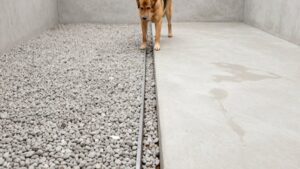
Because standing water can keep a kennel surface wet and harder to clean, slope the concrete floor slightly toward a drain channel. Direct runoff away from the enclosure, and check that it doesn’t collect where your dog rests. After hosing or rain, inspect the surface; persistent puddles signal that drainage needs correction.
For an existing slab, consider:
- Raised modular flooring with drainage gaps to let water pass through.
- Pea gravel over sand as a permeable outdoor surface.
- Annual replacement of pea gravel to maintain the draining layer.
- A clear runoff route that carries water beyond the kennel.
Verify flow across the floor and away from the enclosure, without creating a muddy or hazardous area outside. Make certain your dog can rest on a dry surface.
Conclusion
Choose an outdoor kennel by your dog’s measured adult weight, then confirm the floor space lets your dog stand, turn, and lie down comfortably. Weight charts provide a starting point, not a substitute for checking your dog’s actual dimensions and breed-related needs. Secure the gate, provide shade and fresh water, and make sure the floor drains without creating a slippery slope.
Reassess the setup as your dog grows; a well-sized, safe kennel supports comfort and reduces avoidable injury risks.