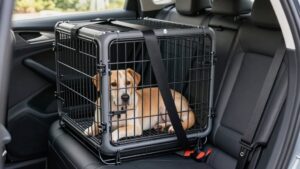
Airline-Approved Dog Crate Sizes: Series 100 to 700 Explained
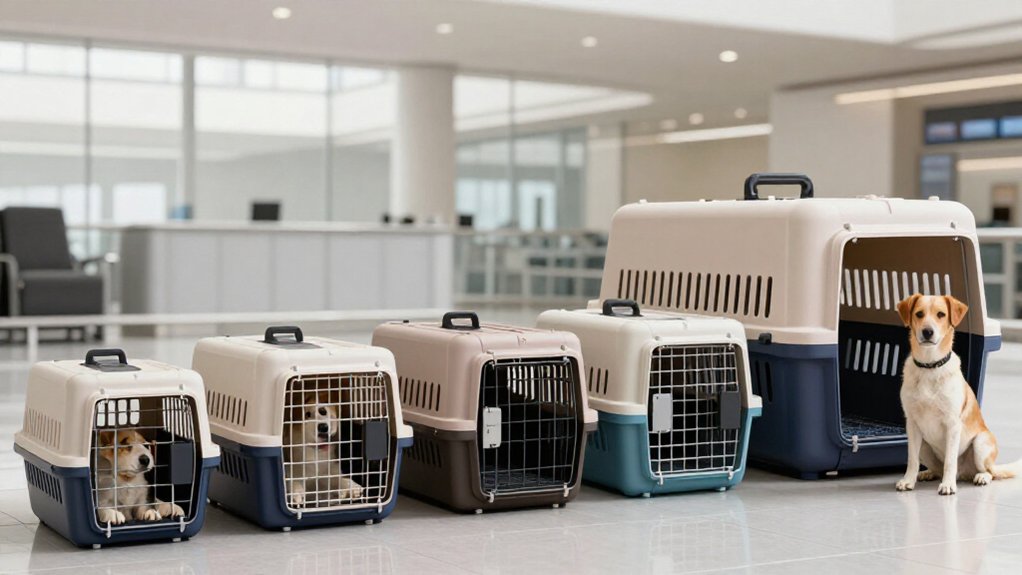
Series 100 to 700 crates span roughly 21 × 16 × 15 to 48 × 32 × 35 inches; listed dog-weight guidance rises from 10 to 20 to 90 to 125 pounds.
Don’t choose by breed or weight alone: measure your dog’s height and length, then check usable interior space. Your dog must stand, turn, and lie naturally.
Airline acceptance depends on current carrier rules, crate construction, and itinerary. Secure the door with metal nuts and bolts, and check the details before booking. More sizing guidance can help you.
Series 100–700 Crate Dimensions
Series 100–700 crates vary substantially in size, and listed dimensions can differ by model or chart. Before choosing a crate, identify the exact model and verify its manufacturer’s current specifications. Don’t assume that a series number alone tells you whether the crate will fit your dog or meet an airline’s rules.
Check the product label and confirm which measurements describe the exterior and which describe usable interior space; those figures aren’t interchangeable. Your dog must be able to stand, turn around, and lie down naturally, while the crate must satisfy the carrier’s requirements for construction, ventilation, and secure closure.
Contact your airline before booking, since acceptance depends on its policies and your aircraft. If listings conflict, ask the seller or manufacturer to clarify rather than relying on an estimate for safe travel.
Series 100–700 Dimensions
Approximate exterior dimensions increase from 21 × 16 × 15 inches for Series 100 to 48 × 32 × 35 inches for Series 700, but some models have different listed measurements. Use these figures as a starting point, not a substitute for checking the exact model.
| Series | Approximate exterior dimensions |
|---|---|
| 100–200 | 21 × 16 × 15 to 28 × 20 × 21 inches; 200 variant: 28 × 20.5 × 21.5 |
| 300–400 | 33 × 22 × 23 inches; intermediate 300: 32 × 22.5 × 24 inches; 400: 36 × 24 × 26 inches, or 36 × 25 × 27 inches; 500: 40 × 27 × 30 inches |
Measure your dog and confirm airline limits; exterior fit alone doesn’t guarantee safe, compliant travel for your route. Check interior space, too, so your dog can stand, turn, and lie comfortably.
Kennel Series Numbering
Those dimensions correspond to kennel series numbered 100 through 700, which generally progress from smaller to larger crates.
The number gives you a size guide: Series 100 is the smallest listed, while Series 700 is the largest option described. Exterior dimensions increase from about 21 × 16 × 15 inches for Series 100 to 48 × 32 × 35 inches for Series 700. Weight ranges also rise, from 10–20 pounds to 90–125 pounds, with intermediate series covering the ranges between.
Don’t choose by the number alone. Measure your dog and check the kennel’s usable interior space, since exterior dimensions don’t describe the room available inside. If your dog exceeds Series 700’s capacity, you may need a different or modified kennel. Confirm that the specific model meets your airline’s requirements before travel.
Breed-Based Size Comparisons
Use breed examples as a starting point: Series 200 often suits small Chihuahuas and Yorkies, while Series 300–500 cover progressively taller medium dogs. Larger breeds may need a Series 700 or PP100, but don’t choose by breed alone. Measure your dog’s sitting height and confirm the crate allows safe, comfortable positioning.
Breed Size Ranges
Breed examples can help narrow your search, but choose an airline-approved crate by your dog’s measured sitting height, not breed alone.
Use the series ranges as a starting point: Series 300 fits a sitting height of 16 to 19 inches; Series 400 covers 20 to 22 inches, and Series 500 covers 23 to 25 inches. Some smaller Labs, Retrievers, cattle dogs, sheepdogs, and most terriers may suit the 500, but individual proportions vary. German Shepherds, Huskies, and larger Labs or Retrievers often need Series 700; a Doberman may need it too, sometimes with a height extender.
Measure your dog standing naturally, then check the crate’s internal dimensions and the airline’s current rules. Your dog must be able to sit upright without its head or ears pressing against the top. Don’t size down to meet a label: confirm the specific model’s fit and approval before travel, and verify its door and ventilation.
Small Breed Examples
For small dogs such as Chihuahuas and Yorkies, a PetMate Series 200 may fit if their sitting height is 15 inches or less; its listed dimensions are 28 × 20 × 19 inches.
Treat that figure as a starting point, not a guarantee: breed labels can’t account for differences in body shape or posture. Measure your dog while seated, then check that the crate lets your dog stand naturally, turn around, and lie down comfortably. Don’t choose a kennel based on weight or breed alone, and verify the airline’s current rules before travel.
Series 100 is listed for small cats and rabbits, not as the usual small-dog option. If you’re transporting a cat, guidance names Series 200 as the minimum and requires mesh. Inspect usable interior space and door clearance, too. Confirm airline acceptance directly before booking your dog’s flight.
Medium Breed Examples
Medium dogs with a sitting height of 16-19 inches generally fit a Petmate Sky Kennel 300 Series (33 × 22 × 23 inches); dogs measuring 20-22 inches typically need a 400 Series (36 × 24 × 26 inches).
You shouldn’t rely on breed labels alone: even within a breed, body proportions vary. Measure your dog while sitting, including the head and ears, then compare the result with kennel interior clearance; listed exterior dimensions may not reflect usable space.
Before travel, confirm your dog can stand naturally without its head or ears touching the roof, turn around freely, and lie down in a relaxed position. If your dog falls between size ranges, choose a kennel that provides adequate room and verify it meets the airline’s current requirements.
A snug fit can restrict movement, while excess space may affect secure transport, so assess your individual dog’s posture and comfort rather than choosing by weight or breed reputation alone; always check fit before booking travel.
Large Breed Examples
Large dogs can need very different kennel sizes: a 500 Series (about 40 × 27 × 30 inches) may fit smaller Labs and Retrievers, cattle dogs, sheepdogs, and many terriers with a sitting height of 23–25 inches, while larger Labs and Retrievers may need a 700 Series (about 48 × 32 × 35 inches).
Huskies and German Shepherds often need a 700 Series; include upright ear tips when measuring sitting height. Dobermans may need the same series, and these three breeds may require a 5-inch height extender.
Very large German Shepherds, Mastiffs, Great Danes, Great Pyrenees, and St. Bernards may suit the larger PP100 kennel. Before travel, confirm your dog can stand, turn around, and lie down comfortably and safely inside the crate.
Breed Isn’t Everything
Breed examples can guide your search, but your dog’s measurements and posture should determine the crate size. Measure your dog with upright ears included, then check whether they can stand and sit erect, turn around freely, and lie down naturally. Sitting height can help you compare series: 300 suits about 16–19 inches, 400 about 20–22, and 500 about 23–25.
Breed labels don’t account for every body. Smaller Labs may fit a 500, while German Shepherds, Huskies, and larger Labs often need a 700, measuring 48 × 32 × 35 inches externally. Long-bodied dogs such as Dachshunds may need extra length, even when their sitting height points to a smaller series.
Before buying, check your individual dog’s fit and required clearance. Some 700-series dogs need a 5-inch height extender; dogs over 25-inch sitting height may need another option. Follow your airline’s current crate requirements.
Measure Height and Length
To size the crate safely, measure your dog standing naturally from the floor to the top of the head or ear tips, whichever is higher, and from the nose to the base of the tail. Then measure sitting height as well; it helps you compare measurements with crate series guidance. For minimum internal length, add half the floor-to-elbow distance to your nose-to-tail-base measurement.
Choose a crate that lets your dog stand and sit erect, turn around, and lie down naturally without touching the top. Allow about three inches of clearance above the head or ears, and include bedding thickness when checking interior height. Sitting height also helps distinguish series: Series 300 covers 16–19 inches, Series 400 covers 20–22 inches, and Series 500 covers 23–25 inches.
Snub-Nosed Breed Limits
Snub-nosed breeds—including boxers, pugs, bulldogs, and Pekingese—may face airline restrictions, and hot-season transport isn’t recommended. Before booking, check your carrier’s current policies; acceptance can vary by airline, route, flight, and date. Confirm that the airline will transport your dog on your specific itinerary.
For sizing, the guidance recommends a crate about 10% larger than standard; small snub-nosed dogs may need the next size up. Don’t choose by breed alone. Measure your dog standing to the top of the head or ears, then account for bedding height.
Your dog must be able to stand without crouching, turn around, and lie down naturally. A roomier crate can support comfort, but it doesn’t override airline limits. Verify the crate’s dimensions against the carrier’s requirements before purchase and travel.
Multi-Pet Kennel Rules
Some airlines allow compatible dogs or cats to share a kennel only with animals of the same species, but age, weight, and group-size limits vary. Confirm limits with your airline; rules differ. Usually, kennel one dog or cat aged six months or older, one puppy or kitten aged 8 weeks to 6 months weighing over 20 pounds, or two similarly sized young animals weighing 20 pounds or less each.
Guidance also permits two compatible adult pets accustomed to living together only if each weighs 14 kilograms or less; heavier pets need separate containers. Shared puppies or kittens must be littermates, under six months, weigh no more than 14 kilograms each, and number no more than three. Under-eight-week animals may qualify if weaned or traveling with their mother; ask the Cargo Call Center about exceptions. Never house a female in heat with a male.
Avoiding Door-Latch Rejection
Because latch rules vary by airline, secure the kennel door with metal nuts and bolts, not dial latches, snap latches, plastic pegs, or clips.
Check that the door is a metal grate; some carriers reject fully plastic doors. Avoid plastic wing-barrel latches, and test the fasteners before check-in so the door can’t open accidentally. Confirm whether your airline permits top-opening or double-door designs; don’t use either if its rules prohibit them.
Before departure, verify current specifications with the airline, since acceptance policies vary and can change. Keep approved hardware installed throughout travel at all times.
- Match the door material and latch type to current airline rules.
- Tighten every metal nut and bolt securely.
- Recheck the closed door before handing over your kennel.
Empty Crate Weight Limits
Once the kennel meets your airline’s door and latch rules, check its empty, or tare, weight: Series 100 weighs 2.8 kg, Series 200 4.65 kg, Series 300 6.75 kg, Series 400 8.4 kg, Series 500 12.25 kg, and Series 700 23 kg.
These figures describe the crate alone, not a maximum dog weight or loaded-crate allowance. For cargo, you must keep your animal and crate together at or below 150 lb; include the tare weight before estimating how much your dog and any permitted contents can weigh. Check the carrier’s current rules, because acceptance conditions may differ by service. Before travel:
- Weigh your actual crate if accessories or repairs may change its mass.
- Add your dog’s weight and the crate’s empty weight; account for other items included in the shipment.
- Confirm the combined total stays within 150 lb, and ask your airline how it measures the shipment.
A safe margin helps prevent delays at check-in. Don’t assume tare figures include bedding, bowls, or other removable equipment.
Conclusion
Before you book, match your dog’s measured height and length to the crate’s interior dimensions, not just its series number or breed guide. Confirm your airline’s current rules for kennel size, door latches, empty weight, snub-nosed breeds, and multiple pets; requirements vary by carrier and route. Your dog must be able to stand, turn around, and lie down comfortably.
When details are unclear, contact the airline and get approval in writing. A careful check helps prevent check-in delays and keeps your dog safer.