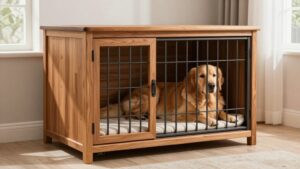
Furniture Dog Crate Size Chart: Inside vs Outside Dimensions by Breed
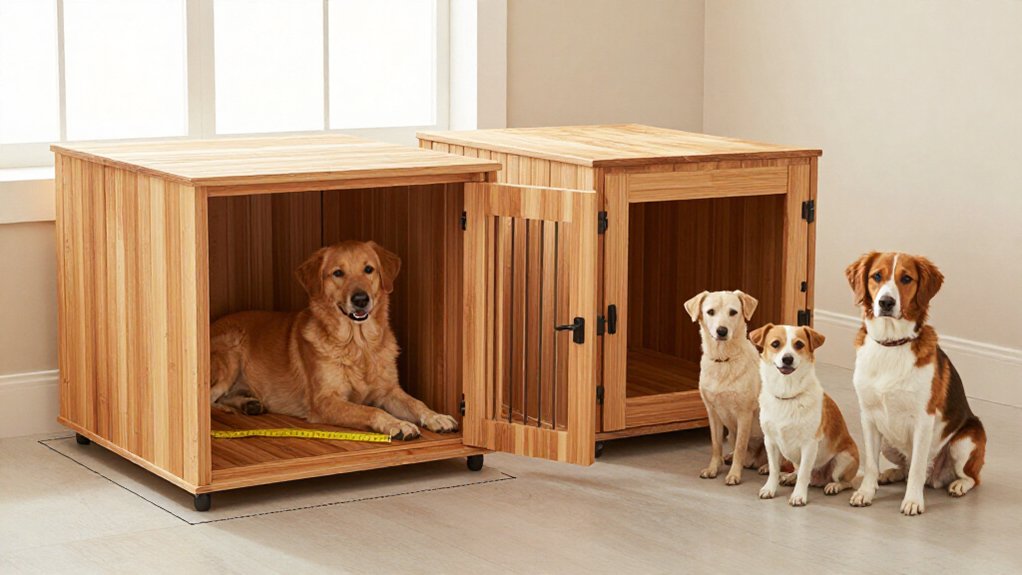
Use breed charts only as starting points; your dog’s build and usable interior space matter more than labels or exterior dimensions. Measure your dog from nose to tail base and floor to head, then add two to four inches for length and height. Your dog should stand, turn, and lie stretched out.
For puppies, choose adult sizing with a divider. Check doorway access, door swing, ventilation, and tray fit. Next, compare size classes and placement needs.
Furniture Crate Breed Dimensions
Breed labels can help narrow your search, but measure your dog before choosing a furniture crate. The listed sizes are starting points, not guarantees: dogs within one breed can differ in height and build. A medium crate, 24″ H × 29.5″ W × 19.5″ D, is listed for French Bulldogs, Pugs, Miniature Poodles, and Shih Tzus.
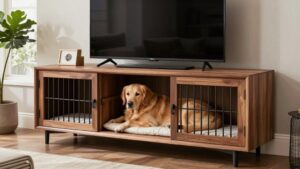
Border Collies, Cocker Spaniels, Pit Bulls, and Boxers are paired with a large crate, 28.75″ H × 36.25″ W × 23″ D. Golden Retrievers, Labradors, German Shepherds, and Huskies are listed for 33.75″ H × 42.25″ W × 28″ D. If you have a Doodle mix, its individual size may call for a large or extra-large crate. Choose a model that gives your dog room to stand, turn, and lie down comfortably; a breed listing can’t confirm an individual dog’s fit.
Inside vs. Outside Dimensions
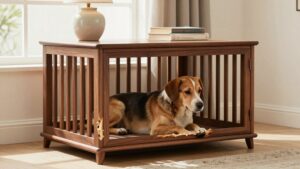
For a furniture crate, choose by interior dimensions—the space your dog can actually use—not the outside measurements, which include the frame.
Measure from nose to tail base and from floor to head or ear tips. Add 2–4 inches to each measurement for minimum usable length and height; your dog must stand, turn, and lie fully stretched. Bedding can reduce clearance, so account for it before buying.
| Example | Listed inside dimensions |
|---|---|
| Medium | 24″ H × 29.5″ W × 19.5″ D |
| Large | 28.75″ H × 36.25″ W × 23″ D |
| Larger models | 33.75″ H × 42.25″ W × 28″ D |
Confirm listed figures are usable interior space, not the furniture’s footprint. Compare inside measurements with your dog and account for bedding; ask the seller to verify interior dimensions if unclear.
Breed Weight Classifications
Once you’ve checked your dog’s usable interior space, breed and weight charts can offer a starting point—but dogs of the same breed can differ in build and size.
Use breed and weight labels as starting points, not guarantees. Medium-class examples include French Bulldogs, Pugs, Border Terriers, Miniature Dachshunds, and Miniature Poodles. Large-class examples include Border Collies, Cocker Spaniels, Cockapoos, Springer Spaniels, and Staffordshire Bull Terriers.
Charts may list Labradors and Golden Retrievers as large or extra-large, and German Shepherds as extra-extra-large; recommendations vary.
Great Danes, Mastiffs, and Saint Bernards typically rate extra-large, but individual measurements should guide your selection. Check that usable interior dimensions let your dog stand, turn, and lie comfortably without restricting movement. If your dog falls between categories, trust measurements over breed estimates.
Doorway Clearance Measurements
Measure the doorway’s clear width and height at their narrowest points, accounting for the door swing, trim, threshold, and nearby obstacles. Compare that space with the crate’s full outside dimensions—including doors and protrusions—and check hallway clearance so you can carry and turn it safely. Before buying, confirm the assembled crate can pass through the route in a workable orientation, including during delivery.
Measure Doorway Width
Before choosing a furniture-style dog crate, check that it can pass through every doorway, hallway, and passage on the route. Measure the narrowest clear opening along that route, including its frame and molding. Compare this clearance with the crate’s largest outside dimension, not its interior width; walls, trim, and decorative panels can add bulk.
Allow extra maneuvering space beyond the crate’s measurement so you can tilt or turn it without scraping doorframes or walls. Check the assembled dimensions, too, and confirm whether doors, removable panels, or hardware reduce the available opening during transport. If the crate won’t fit through the intended doorway, choose a model with removable components or assemble it inside the room, if its design allows. This check helps prevent costly damage.
Account for Door Swing
After confirming the crate can reach its intended location, check that its door can open fully without blocking a walkway or striking nearby objects. Measure the door’s full swing, often 90 degrees, and keep its entire arc clear of walls, furniture, and walking routes. Check the door width and how far the open panel extends beyond the crate’s exterior; reserve at least that distance in front.
If the door opens from the side, measure clearance beside that side rather than only in front. Include handles, latches, and other hardware that protrudes as you open or close the door. Then compare the required clearance with the room’s usable floor space before choosing a placement. Check before you settle.
Compare Overall Crate Width
Check the doorway’s narrowest clear opening, including trim, handles, and other obstructions, and compare it with the crate’s widest exterior point.
Use overall width, not interior width: walls, framing, and trim extend beyond the dog’s usable space. Measure the opening where clearance is smallest, then compare that figure with your furniture model’s outside width. Breed charts may list a Medium crate at 29.5 inches wide and a Large at 36.25 inches, but those examples don’t confirm your model’s exterior measurement.
Check specifications or measure the crate, including hardware. The crate should pass through without tilting, scraping, or forcing it; these actions can damage furniture or strain you. Leave extra room to maneuver, and verify whether removing the door or another part reduces its transport width. Don’t assume interior dimensions predict doorway fit.
Check Hallway Clearance
Measure the full route to the crate’s intended spot, including the hallway’s narrowest point, every doorway, and tight corners. Record each clear opening, accounting for baseboards, trim, and handles that reduce usable space. Compare these measurements with the crate’s outside width and depth, including projecting feet and hardware; interior dimensions won’t tell you whether it will pass. Allow extra clearance; an exact fit risks scraping or damage.
Check the crate’s widest orientation and confirm you can turn it in the hallway without striking walls. If it arrives assembled, verify its outside dimensions fit every doorway along the route. If not, confirm you can assemble it in the intended room. Measure before choosing a location to protect your walls and avoid damage and awkward maneuvering.
Plan Delivery Access
Once you’ve chosen a spot, plan how the crate will reach it: measure the narrowest doorway, hallway, and turn along the delivery route, then compare those clearances with the crate’s outside width, depth, and height. Don’t rely on the front door alone; bottlenecks farther inside can prevent delivery or force unsafe lifting. Measure usable opening dimensions with doors fully open, and account for handles, trim, protective packaging, and room to pivot the crate.
An opening matching the crate’s dimensions may still be too tight. Ask whether the seller can deliver it unassembled; removable panels or flat-pack construction may ease access, but confirm assembly requirements and safe handling. For bulky furniture-style models, verify the route and delivery options directly with the seller before you order.
Measure Your Dog’s Sleeping Posture
Because dogs need room to move naturally, choose a crate that lets yours stand without crouching, turn around, and lie fully stretched out.
Measure your dog standing, then compare the crate’s usable interior with their body dimensions. Measure from nose tip to tail base for length and from floor to head or upright ears for height. Add two to four inches to each measurement as a minimum.
Watch your dog sleep. If they’re a curler, leave enough space to change position; if they sprawl, make sure their legs extend without touching the walls. Also allow two inches of head clearance when your dog sits.
Finally, account for bedding or a mat, which reduces usable space. Confirm these checks inside the crate before choosing dimensions.
Puppy Growth and Crate Sizing
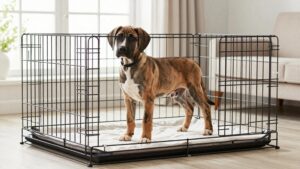
For a puppy, size a furniture-style crate for its expected adult measurements, not just its current size or breed size. Measure your puppy from nose to tail base for length, and from floor to the top of the head or ears for height. Add 2–4 inches to measurement to estimate dimensions. Choose an adult-size crate with a removable divider, then move it as your puppy grows.
Set the divider so your puppy can stand without crouching, turn around, and lie down. Limit unused space during housetraining, since excess room may encourage accidents. Check the crate’s interior dimensions against fit requirements; outside measurements don’t show how room your puppy has inside. Include bedding in your assessment, because it reduces usable space.
Recheck fit as growth changes your puppy’s measurements.
Furniture Crate Placement Tips
Before choosing a spot, measure the furniture crate’s exterior and check nearby doors, drawers, and walkways to confirm it won’t block access or circulation. Remember that interior dimensions differ from exterior ones, the walls and frame cut into the space your dog actually gets, so don’t rely on outside measurements alone when sizing for comfort.
Leave clearance around the crate so its door can swing fully open and you can slide out the tray or reach inside to clean. Set the crate on a stable, level surface, away from direct heat sources and drafts, with room for your dog to enter and exit without squeezing past furniture.
Pick a location that matches your room’s layout and gives your dog a calm, quiet resting spot, while keeping the crate easy to reach for daily use.
Furniture Crate Ventilation Checks
Once you’ve placed the furniture crate, check that air can pass through the door and openings on multiple sides, especially if it sits against a wall.
Use these checks:
- Check usable interior space, not exterior dimensions, against your dog’s size; bedding shouldn’t block vents or crowd airflow.
- Keep openings clear of blankets, cushions, and stored items, and leave the clearance the design requires.
- Test airflow at the door and side or back panels; few openings can leave a solid enclosure stuffy.
- After setup, feel for trapped warmth and check for stale air, especially in warm weather; reposition the crate or improve airflow if needed.
A comfortable fit needs circulation: assess your dog in the usable interior, then confirm air moves carefully after arranging bedding.
Removable Tray Dimensions
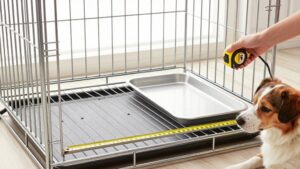
Measure the removable tray’s usable interior length and width, not the crate’s exterior dimensions, which include the frame and can overstate the available floor space.
Compare tray dimensions with crate interior measurements; rails or lips can narrow usable area. Verify the listed fit for your exact crate model and size; similar exterior measurements don’t guarantee compatibility. Check four details:
- Match the tray’s length and width to the original.
- Confirm its shape, including rounded corners and fitted edges.
- Check clearance around rails and lips so the tray sits flat.
- Subtract bedding or a mat from the floor space your dog can use.
A loose tray can shift or leave gaps. Confirm fit before use; make sure bedding doesn’t crowd your dog or restrict movement.
Conclusion
Choose a furniture crate by checking its usable inside dimensions—not just its listed outside size—against your dog’s sleeping posture and expected adult growth. Confirm the doorway clears your route, the tray fits, and ventilation remains unobstructed after placement.
Breed and weight charts offer starting points, but your dog’s measurements matter more. Before buying, compare every measurement with the manufacturer’s specifications. A properly fitted, secure crate gives your dog room to rest while helping you avoid cramped space, blocked airflow, and costly sizing mistakes.