Should You Crate a Dog With Separation Anxiety? When It Helps or Hurts
Crate your dog with separation anxiety only if they remain relaxed and can rest; confinement may intensify panic.
Watch the first 30 minutes after you leave for panting, pacing, drooling, nonstop barking, or escape attempts.
If distress escalates or your dog risks injury, stop crating and consider a secure, gated room while you consult your veterinarian.
A camera can reveal patterns.
You’ll check whether the crate’s setup and safety features support comfortable confinement.
When Crating Worsens Anxiety
When a dog has separation anxiety, crating may intensify the panic rather than ease it. A crate can’t resolve the fear underlying your dog’s distress when you leave. Dogs may begin panicking within about 30 minutes, showing stress through panting, circling, drooling, or continuous barking and howling.
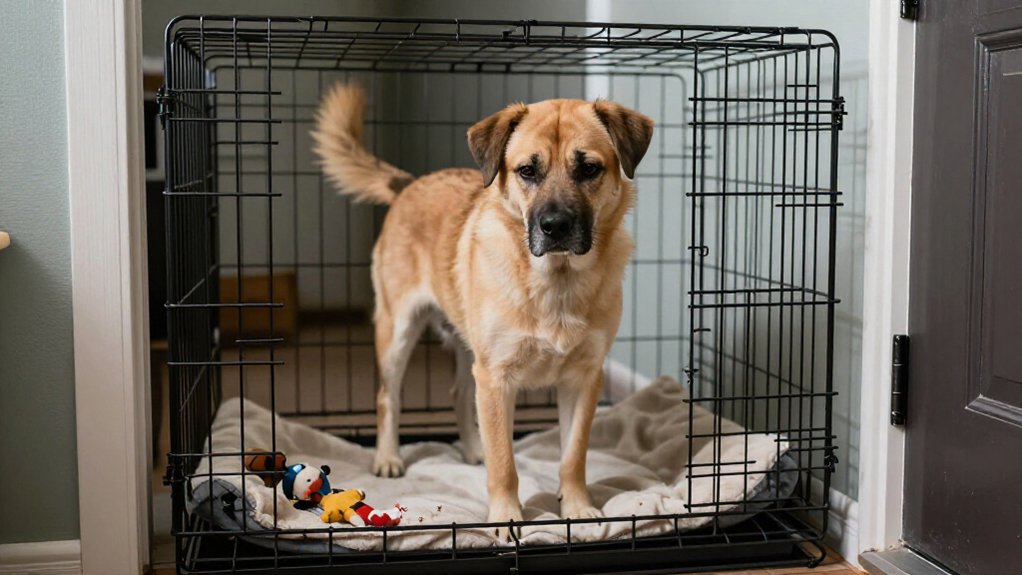
Confinement may prompt escape attempts. Because the crate blocks escape, your dog could break teeth, bloody paws, or nails while chewing or crashing against it.
Owners report chewing, digging, scratching, and urination or defecation in the crate, even in house-trained dogs. These behaviors aren’t defiance; separation anxiety is a panic disorder, not misbehavior. If you use a crate as your response, your dog may associate being left alone with fear rather than learn to relax. A crate may worsen distress and increase injury risk.
Identify Your Dog’s Panic Triggers
If crating may worsen your dog’s distress, identify what triggers the panic and when it begins. Watch for symptoms that start within about 30 minutes of your departure, when howling, barking, drooling, pacing, or circling may intensify. Note cues that reliably come first, such as picking up keys, putting on shoes, a move, a job change, or a household member’s or pet’s departure.
Track whether problems occur only while you’re away; your dog may seem settled with you home yet urinate or damage items during absences. Use a camera to review the first half-hour: footage can reveal whether departure cues, absence, or confinement precedes distress, while others may miss its timing. Discuss the pattern with your veterinarian to choose an appropriate treatment step together.
Crate Escape and Injury Risk
A dog in a panic may thrash or claw frantically to escape a crate, risking broken teeth, injured or bloody paws, and torn nails. This isn’t ordinary chewing: severe separation anxiety can trigger fight-or-flight responses that prevent your dog from stopping or thinking clearly. Your dog may become trapped or pinched during frantic movement, even in a sturdy crate.
| Panic behavior | Possible harm | What you can do |
|---|---|---|
| Thrashing or clawing | Teeth, paw, or nail injuries | Stop unsupervised crating |
| Trapped movement | Pinching or injury | Monitor with a camera |
If your dog attempts escape, treat the crate as unsafe for now. Adjust training carefully and use camera monitoring to identify distress; don’t assume your dog can settle. Preventing panic-related injury should guide your next steps. A crate isn’t safe simply because it’s sturdy or familiar.
Crate Versus Safe Room
If your dog panics when you leave, drooling, barking nonstop, or trying to escape, a crate may increase distress and injury risk. A gated safe room can offer space to move while limiting destruction, but choose the setup that fits your dog’s behavior.
Test it with video monitoring, and keep absences below your dog’s panic threshold as you work on gradual desensitization.
Crate Containment Risks
Because separation-related panic often peaks within the first 30 minutes after you leave, choose confinement carefully. A crate can trap a panicked dog, and frantic attempts to escape may cause broken teeth, bloody paws, or torn nails. The barrier may also intensify distress: when your dog fears being alone, confinement can amplify the fight-or-flight response rather than calm it.
If your dog has damaged a crate before, don’t use it while you’re away; impacts against bars or latches can cause further injury. When you need to manage absences, consider a secure room with baby gates and camera monitoring so you can observe your dog’s response.
Avoid extended crating; reserve it for brief, gradual training steps only when your dog remains calm. If distress escalates, stop and seek guidance from a veterinarian or qualified behavior professional.
Safe Room Benefits
When separation anxiety triggers panic, a gated safe room can offer more usable space and reduce the risk of injury from frantic escape attempts. A crate may intensify fear when you leave, contributing to panting, drooling, frantic escape, or self-injury. In contrast, a room or pen can make escape attempts less dangerous while letting you observe distress.
Review camera footage, especially during the first 30 minutes, to identify signs that can guide gradual desensitization. Use the space as a supportive step toward teaching your dog to cope with alone time, not as punishment for accidents. You may still need to manage hazards and supervise changes; a safe room isn’t a cure or a substitute for individualized behavior support. Avoid forcing confinement that worsens anxiety.
Matching Space to Behavior
Choose the space that matches your dog’s response to confinement: a crate may intensify panting, drooling, circling, or vocalizing, while a gated safe room can offer a less restrictive boundary. If your dog shows escalating distress within 30 minutes of being left alone, especially escape attempts or nonstop barking, a safe room may be more appropriate.
Confinement can add stress when your dog feels trapped; reducing barriers may lower panic and injury risk. Keep the area bounded and only as large as needed, with enough room to move comfortably. This balance limits opportunities for destructive behavior without imposing tight confinement. If your dog has accidents there, treat them as signs of stress, not defiance. Don’t punish; adjust access and management rather than increasing confinement.
Testing Each Setup
Use a camera to compare a crate with a gated safe room during the first 30 minutes after you leave, when signs of separation-related distress often emerge.
Watch for frantic escape attempts, excessive drooling, panting, circling, or injury. If these appear in the crate, confinement may be intensifying panic; don’t wait for your dog to “get used to it.” Try a loose-placement setup instead: gate access to a safe room, such as a kitchen, and let your dog move freely within it.
Compare the video for reduced distress, not merely quiet. A safe room can provide a less restrictive management bridge while you train absences. Crating generally isn’t recommended for separation anxiety when supervised, lower-restriction options are available. If neither setup is tolerated and panic continues, don’t extend absences.
Return to shorter, easier practice sessions and reassess your dog’s behavior on camera, with your veterinarian or qualified behavior professional as needed.
Signs Crating Is Helping
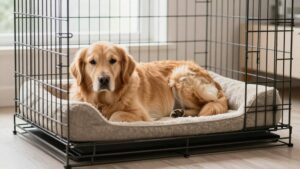
You can assess whether crating helps by checking if your dog stays calm and settles, with relaxed body language, during absences. Resting without distress and choosing to enter the crate can be encouraging signs.
Use a camera to track these behaviors and watch for worsening stress, escape attempts, or accidents.
Calm, Settled Behavior
If your dog can settle during short departures, especially within the first 30 minutes, with little vocalizing, panting, drooling, or pacing, the crate may be helping. Brief, low-intensity whines that fade quickly can also fit this pattern, provided they don’t escalate into frantic circling or attempts to escape.
During crate time, watch for steady breathing and the absence of frantic panting, heavy drooling, or self-injury; these signs suggest management, not panic. Clean outcomes matter, too: no urination, defecation, destructive chewing, or scratching supports the impression that your dog isn’t experiencing high-anxiety distress.
Try a pause-and-release check: release only after an even two- to three-second quiet moment. If your dog settles again promptly, they may be learning to calm rather than remaining distressed over repeated sessions.
Relaxed Body Language
When crating is helping, your dog’s body stays loose, with soft eyes and steady, normal breathing. During your absence, look for a comfortable posture rather than tense muscles, frantic panting, or circling. Your dog may briefly settle quietly, lie down, and rest without repeated pacing, whining, howling, or attempts to escape.
Calmly eating or working on a food puzzle also suggests your dog can engage instead of refusing food or becoming distressed. Check for signs of harm, too: accidents in the crate, excessive drooling, frantic clawing, chewed paws, or broken nails call for reassessment. If you monitor your dog, pay attention to the first 30 minutes after you leave. A lack of escalating distress then supports that crating is helping, though progress can vary.
Choosing the Crate
A crate is more likely to help if your dog can rest comfortably in it while you’re home, with minimal panting or drooling and no frantic circling or escape attempts. Look for distress that stays stable during short practice sessions rather than surging mainly when you leave. Your dog should have enough room to stand, turn, and lie down, without eliminating in the crate.
Keep training absences brief; avoid crating continuously for more than about five hours without a break. Track your dog’s behavior over time, since escalating stress suggests the setup isn’t helping. Treat vocalizing within 30 minutes, destruction, soiling, or injury-risk escapes as reasons to stop and consult your veterinarian, especially if distress rises after you leave the room.
Resting Without Distress
During practice, signs that the crate is helping include your dog resting quietly or sleeping, even when you step away, and staying calm as you prepare to leave and during the first 30 minutes. Look for relaxed posture and manageable arousal, not nonstop barking or howling.
At home, build closed-door time from five to ten seconds toward one or two minutes, without panic. Check for broken nails or teeth, bloody paws, or repeated accidents; these may signal distress. Your dog should remain calm as you prepare to leave; quiet resting during home practice alone can’t confirm comfort when you’re gone. Monitor the first half-hour after leaving. If distress spikes at departure, the barrier may intensify abandonment panic; seek veterinary or behavioral guidance.
Ventilation and Temperature Control
Because separation-related panic can lead to heavy panting and drooling, keep the crate well ventilated and the room at a comfortable temperature.
Keep sides open and airflow unobstructed; anxiety can also increase panting, while poor ventilation may worsen distress and raise overheating risk in a warm room, especially inside a crate.
Place the crate away from direct sun, heaters, and air-conditioning drafts. If you use a cover or cave-style setup, ensure air can circulate around it; a cover may trap heat.
Monitor your dog during stress events for heavy panting, drooling, or lethargy. These signs can reflect thermal discomfort or worsening distress. Improve the environment and contact your veterinarian if symptoms persist. Confinement and heat can compound distress, so don’t dismiss changes as anxiety alone. Your dog’s comfort deserves close attention whenever you’re away.
Door Latch Durability
Even with good ventilation, a panicking dog may repeatedly try to escape, so check that the crate door has a secure, high-tensile latch rather than a loose or flimsy catch. A weak latch can fail quickly, risking broken teeth, bloody paws, or nail and skin injuries. Choose a secured, high-tensile mechanism; even a sturdy crate may fail when your dog panics. Before each use, check for door movement, misalignment, or springback.
Camera monitoring can reveal circling, drooling, or howling. A secure latch may give you time to intervene and restart training before injury occurs. Still, it’s only a safety layer, not anxiety treatment: if your dog panics alone, crating remains risky.
Ask a behavior professional about management and gradual, individualized separation training for your dog.
Sharp Edges and Protrusions
Choose an inspected crate with smooth, rounded surfaces and no exposed screw points, broken bars, or sharp latch hardware. An anxious dog may ram, claw, or bite during acute distress, so even brief panic can turn a protrusion into a serious hazard. Separation distress can escalate within about 30 minutes after you leave; inspect the crate before each use.
- Check the latch and joints for sharp edges and secure closure; leave no gaps that can catch paws.
- Run your hand along bars and seams; reject any crate with a broken bar, exposed screw, or protrusion.
- Watch for crate-driven escape attempts; a barrier may intensify thrashing against unsafe hardware.
- If your dog bites or claws the crate, avoid unsupervised crating and ask your veterinarian about safer support.
Escape-Resistant Crate Materials
For a dog who stays calm in a crate, heavy-gauge welded wire or impact-resistant metal bars can resist bending during escape attempts. Still, frame strength alone won’t make confinement safe; anxious dogs may exploit weak hardware or injure themselves at openings.
Check these features before choosing a crate:
- Select a double-latch or locking-slide mechanism; the lock can prevent escapes through weak closures.
- Choose a tight-fitting door with minimal gaps, reducing places for paws or teeth to catch during lunges.
- Size the crate so your dog can stand, turn, and lie down. Excess space may increase accidents and undermine containment.
- Watch for drooling, circling, howling, or self-injury. If panic occurs, strong materials may trap and intensify distress; consult your veterinarian about safer support.
Conclusion
Whether you crate your dog depends on how they respond, not a rule. If confinement triggers panic, escape attempts, or injury, don’t force it: choose a secure safe room and consult your veterinarian or a behaviorist. If your dog relaxes in the crate, keep sessions gradual and positive.
Check ventilation, temperature, sturdy latches, smooth surfaces, and escape-resistant materials. Track behavior when you leave; adjust the plan to protect your dog’s safety and support confidence.