How Tall Should a Dog Gate Be? Height Guide by Dog Size and Jumping Ability
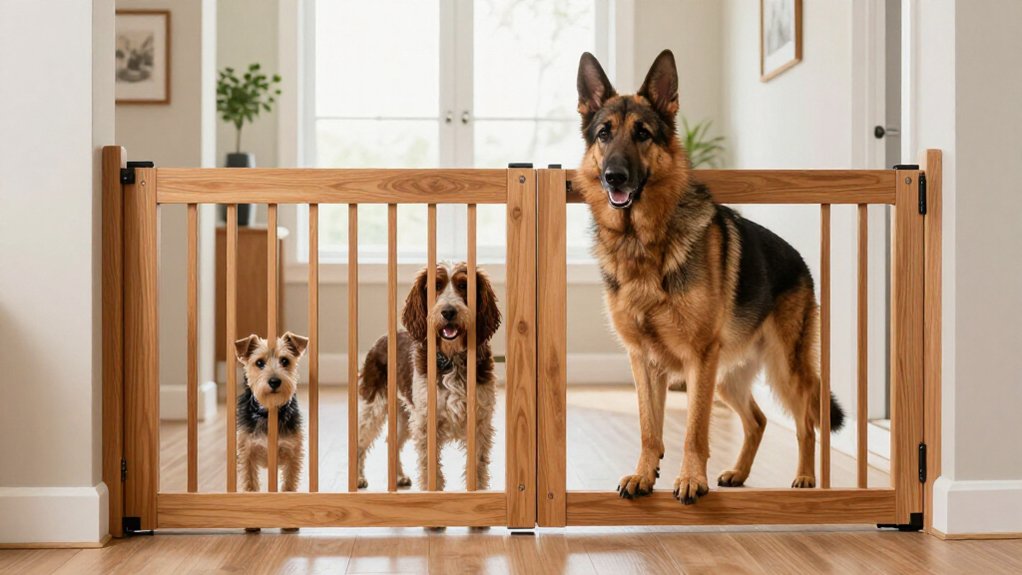
Choose a gate at least 30–35 inches tall for many small dogs and 36–40 inches for large or athletic jumpers. Measure your dog at the shoulders, but don’t treat that height as a jumping limit.
A 34-inch gate may suit a small puppy, yet growth or motivation can change escape risk. Check climbing, pushing, gaps, the latch, and launch points, then supervise use.
For stair landings, choose hardware-mounted gates. The guide below shows how to tailor choice.
Height by Jumping Ability
A 34-inch (86 cm) gate stands 10 inches above the 24-inch jump height used in the tallest AKC Regular-class agility division, but that trained height doesn’t show a dog’s maximum ability. Fit, tall, or athletic dogs may clear that height, so don’t treat 34 inches as guaranteed containment. Most dogs that escape climb rather than jump, so a smooth gate without footholds may deter more dogs than a taller bar-style design.
Place the gate in a hallway to limit your dog’s run-up, and supervise early to see whether it holds. Choose for your individual dog’s jumping ability and behavior, not breed alone, and don’t reward attempts to cross. If your dog tests the barrier, choose a secure option and supervise rather than relying on height alone.
Gate Height by Breed
Choose gate height for your dog’s size and behavior, not breed alone: a 20-inch gate may suit a puppy or small dog, while larger dogs or jumpers may need one at least 30 inches high.
Gate Height by Breed
| Dog type | Starting point |
|---|---|
| Small breeds or puppies | 20 inches |
| Athletic or large dogs | 30+ inches |
Treat these as starting points, not guarantees. A 34-inch gate without footholds can deter many dogs, which may climb or squeeze beneath rather than jump. Your athletic dog may still clear it; place the gate where he can’t run at it, and supervise early use. Move furniture that could serve as a foothold. If your dog tests or gets through, choose a setup instead of relying on height alone.
Measure Your Dog’s Height
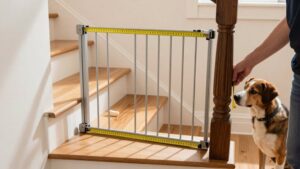
Measure your dog while he’s standing naturally, from the floor to the top of his shoulders (the withers), not his head, which shifts with posture. Use a level surface and keep all four paws planted; a tape measure or a straight ruler held beside him can help you get a consistent reading. Record the result in inches or centimeters so you can compare gate options.
Treat shoulder height as a reference, not a prediction of jumping ability. For context, AKC agility jump heights range from 8 inches for dogs up to 11 inches at the withers to 24 inches for dogs over 22 inches. Those competition settings don’t define what your dog can clear at home. If your dog’s fit or athletic, he may jump higher; weigh his actual ability and past behavior when choosing a gate.
Minimum Height Safety Margins
Use your dog’s size as a baseline, then add a jumping margin: a 34-inch gate sits 10 inches above the 24-inch agility jump height listed for the tallest Regular-class dogs, but that figure doesn’t measure maximum ability. For large dogs that jump, 36–40 inches is a starting range, not a guarantee; account for nearby launch points and choose more height if your dog’s cleared barriers before. Check for climbing, pushing, and squeezing risks—not just gate height—and reassess as your dog’s fitness, motivation, or environment changes.
Baseline Height by Dog Size
As a starting point, a 30–35-inch gate often suits smaller dogs, while large or athletic dogs that may jump typically need at least 36 inches. Treat these figures as starting points, not guarantees. A 20-inch gate may work for a puppy or small breed, but choose a taller barrier if your dog can jump it.
For many small and medium dogs, a 34-inch gate without footholds can provide a useful boundary; however, a determined dog may still clear it. For a large dog, begin at 36 inches, and consider a 36–40-inch model when jumping is likely. Don’t choose by breed label or body size alone: watch how your dog moves and judge its actual jumping ability.
Check that the gate fits securely and has no nearby furniture or other surfaces your dog could use to climb. Reassess as your puppy grows or your dog’s behavior changes or its activity level shifts.
Add a Jumping Margin
Choose a gate that stands well above your dog’s demonstrated jump rather than matching it exactly. A small extra margin matters because a dog may clear a barrier that matches a jump it has already managed. Use agility heights only as reference points: the tallest Regular-class division jumps 24 inches, so a 34-inch gate gives 10 inches of added height.
That comparison isn’t a maximum-capability limit. A fit, tall, or athletic dog may still clear 34 inches, so assess your individual dog rather than relying on breed or size labels. For a large or athletic dog, supervise early gate use and watch for attempts to jump. Also check whether your dog can climb, squeeze underneath, or push through; added height won’t stop those routes.
Account for Nearby Launch Points
Even a gate with extra height may be easier to clear if your dog can launch from nearby furniture or a raised surface. Measure gate height from the floor, and check the space around it for couches, benches, shelves, or stairs. A nearby launch point can make a barrier lower, so move furniture and objects away where possible.
If you’re choosing a location, consider a hallway: its narrower approach can limit your dog’s run-up and reduce momentum compared with an open area. A 34-inch (86-cm) gate may stop many dogs, but it won’t guarantee containment for a fit, athletic jumper, especially beside a launch surface. Supervise your dog’s use. If your dog tries to jump or gets over, reassess placement and gate height.
Check Climbing and Squeezing Risks
A gate’s height won’t prevent escape if your dog can climb it or squeeze through gaps, so match the design to your dog’s habits. Measure the floor and side gaps, especially for a small dog; keep them no wider than two inches.
For medium and large dogs, follow guidance limiting gaps to three inches. If your dog climbs, avoid horizontal bars, rails, and braces that offer footholds; taut mesh has no rungs. A 34-inch (86-cm) gate with no panel gaps and minimal bottom clearance can block common escape routes. After installation, check for liftable corners and openings beneath or beside the panel. Choose a gate taller than your dog’s demonstrated climbing ability, but don’t treat any height as a guarantee against a determined, athletic dog alone.
Reassess as Needs Change
As your puppy grows, gains confidence, or starts testing the barrier, reassess whether the gate is still high enough. A gate that once seemed like a wall may stop containing your dog as its strength and jumping skill develop. Choose a height for your dog’s current ability and behavior, not breed alone.
A fit, tall, or athletic dog may clear a 34-inch gate. For context, 34 inches is 10 inches higher than the 24-inch agility-jump height for the tallest Regular-class division. That comparison doesn’t guarantee containment: a determined large dog can jump higher. If your dog starts jumping or escaping, consider a taller barrier and reassess its placement. Also check beneath and beside the gate for gaps, and remove footholds that could help your dog climb over.
Match Gate Height to Jumping Ability
Because dogs differ in athleticism and motivation, choose a gate for your dog—not just its breed. A 34-inch (86 cm) gate without footholds can stop many dogs, but a fit, tall, athletic, or determined dog may still clear it. Don’t rely on breed charts alone; assess what your dog can do and how strongly they want to get through.
AKC agility jump heights range from 8-inch jumps for dogs up to 11 inches at the withers to 24-inch jumps for dogs over 22 inches tall. These aren’t limits on your dog’s jumping ability. Limit run-up by placing the gate in a hallway or confined spot. Keep furniture away, since it can serve as a launch point. Supervise use, especially if your dog has escaped before.
Stair Landing Height Risks
At a stair landing, secure the gate firmly: a weak barrier can give way if your dog leans or pushes against it, risking a fall.
Avoid pressure-mounted gates at stair tops; they can slip or create a trip hazard. Choose a hardware-mounted or suitable banister-to-banister gate. Check that it’s level and firm, then test it with light pressure. Inspect fittings regularly and tighten any loose ones.
If your dog leans on the gate, a floor hook at the bottom of the flight can also add support. Keep the landing clear. If your senior dog hesitates, lands awkwardly, or refuses stairs, don’t force use; seek veterinary advice. Install it according to the manufacturer’s instructions, and confirm its latch closes securely each time you pass through.
Puppy Growth Adjustments
Unlike a stair landing, a puppy’s gate needs reassessing as they grow: a 34-inch (86 cm) barrier may contain a small puppy, but stronger jumping or climbing skills can change that.
All three SnugGate sizes share the same 34-inch panel, so a wider model won’t add height as your puppy grows.
Supervise use, and reassess as your puppy gains strength and coordination.
If your puppy starts climbing, pushing, or getting over the barrier, change the setup promptly rather than assuming the fit remains safe.
A determined adult dog may clear 34 inches, so treat this height as a temporary solution, not a guarantee for every life stage.
While your puppy learns, consistently block access beyond the gate; don’t let passage teach them to cross it.
Preventing Gate-Climbing Leverage
To make a 34-inch (86 cm) gate harder to climb, choose a design without horizontal bars, rails, or braces that can serve as footholds.
A taut woven-mesh panel offers no rungs, so it may resist climbing better than a taller bar-style gate. Still, height alone won’t prevent every escape; check the fit and setup.
- Keep the bottom gap minimal, and check beside the gate; small dogs may squeeze through or push underneath.
- Choose taut mesh that won’t bulge outward; a bowed panel can create a corner foothold.
- Move furniture and climbable objects away, then supervise early use so you can interrupt climbing before it becomes a learned escape route.
Repair damage promptly; keep your panel taut and safe.
Check Gate Latch Clearance
Check the gate’s full height at the latch, since a raised frame or latch can leave a lower point a dog may exploit. Measure from the floor to the gate’s lowest edge; keep the bottom gap minimal so a small dog can’t squeeze underneath. A secure closure should leave no opening wide enough for your dog to push through.
- Follow the installation guide and align the latch as directed.
- After installation, gently push the gate; confirm it stays closed and doesn’t lift at the corners.
- Recheck latch alignment and floor clearance regularly, especially after someone leans on or pushes the gate.
A gate’s height won’t help if a gap or loose latch creates an escape route. Recheck before leaving your dog nearby.
Conclusion
Choose a gate based on your dog’s height, breed, and demonstrated jumping ability—not size alone. Measure your dog, allow a safety margin, and reassess as your puppy grows. At stair landings, prevent climbing leverage and check that the latch stays securely out of reach.
If your dog can clear or climb the gate, don’t rely on a taller barrier alone; supervise, block access, or use a secure alternative. A well-fitted gate reduces risk, but it can’t replace supervision.