What Is a Crash-Tested Dog Crate? CPS Certification Explained
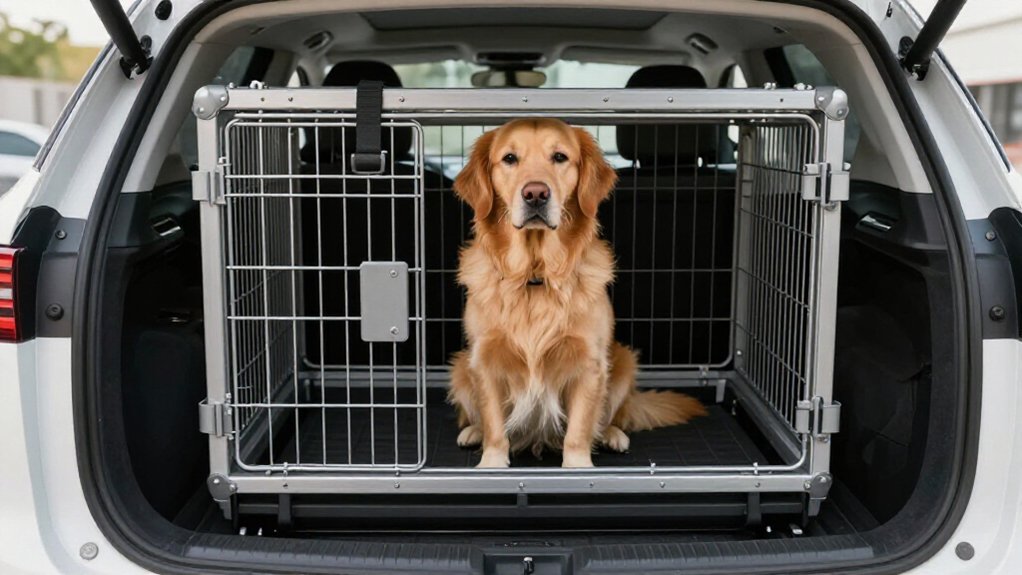
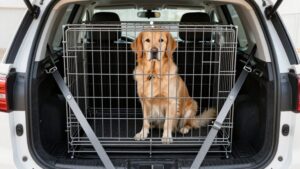
A crash-tested dog crate has undergone independent sled testing to assess whether it stays intact and contains your dog in a simulated 30-mph crash.
The Center for Pet Safety (CPS) evaluates the shell and checks positioning, anchoring, door and lock function, and ejection risk in impacts.
A “crash-tested” marketing claim alone isn’t proof of certification.
You’ll need compatible vehicle anchors and correct tie-downs, too; the details below can help you choose and secure a crate.
CPS Certification Criteria
What makes a dog crate CPS-certified? The Center for Pet Safety (CPS) evaluates crates under its Pet Travel Crate Crash Test Protocol and Rating System, not a maker’s marketing claim. At MGA Research Corporation in Virginia, testers use a sled impact to simulate a 30 mph crash. Dog test dummies inside the crate experience high G-forces, helping assess how the product performs in a vehicle accident.
CPS checks three practical outcomes. The crate must retain structural integrity rather than collapse or break apart. It must contain the dog securely, so the animal stays positioned and doesn’t become a projectile. Its door and locks must also continue functioning after impact. Certification indicates that a product meets the protocol’s consistent performance thresholds. That’s evidence, not advertising.
Why Crate Anchoring Matters
A crate’s crash-test rating matters only if it’s secured to your vehicle. A crash-tested crate relies on more than a strong shell: its tie-down pins, D-rings, or other connection points must stay secure. If you don’t attach those points to the vehicle’s required crash-rated anchors, the crate can move and become a projectile, putting you and your dog at risk.
CPS evaluates containment and structure, including door and lock function, during a crash-equivalent sled test. Its protocol anchors the crate with straps or tie-downs, making correct vehicle rigging part of meaningful performance. The ASPCA also cautions that crating your dog isn’t enough if the connection points aren’t secured.
Follow the manufacturer’s instructions and attach each required point to the specified vehicle anchor before travel.
What 30-MPH Testing Reveals
At 30 mph, CPS testing reveals whether a crate can contain a dog and stay structurally sound under crash forces, not just whether it survives the impact.
A 30-pound dog can experience forces comparable to 600 pounds or more, so you need evidence beyond a crate that looks intact. CPS uses an independent protocol to assess containment, structural integrity, secure positioning, door and lock function, and projectile risk.
| Test focus | What you should look for | Why it matters |
|---|---|---|
| Containment | Test dog stays inside | Limits ejection risk |
| Crash response | Controlled deformation | Shows performance under load |
Review results across the crash timeline, especially maximum deceleration around 0.05–0.15 seconds. A crate’s survival doesn’t prove it protected the dog. CPS certification gives you evidence of crashworthiness, unlike claims that testing occurred.
Plastic Versus Aluminum Construction
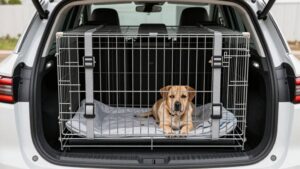
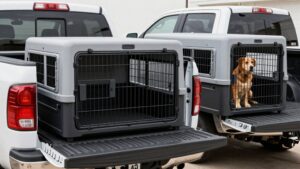
When you compare plastic and aluminum crates, consider how each manages impact: double-wall plastic can deform to absorb energy, while rigid aluminum transfers more force to its restraints. You’ll also want to weigh aluminum’s structural rigidity against each crate’s weight and durability for everyday use.
CPS testing checks whether doors, latches, and tie-down connections still work after impact.
Impact Absorption
In a CPS crash test, a crate’s material affects how it absorbs impact, limits deceleration forces, and keeps your dog contained. A rotomolded double-wall plastic crate uses a crumple zone and air gap: its outer wall deforms first, the gap compresses, and the inner wall provides another layer of protection.
That staged response can absorb energy as your dog moves forward, helping limit deceleration during peak loads. Heavy-gauge welded aluminum, typically 0.063–0.125 inch thick, responds differently: it acts as a rigid barrier and transfers force through tie-down straps to vehicle anchors.
In a modeled 30 mph sequence, plastic begins deforming before the dog reaches the front wall; aluminum stays more rigid at contact. CPS evaluates containment and force management at roughly 20–30 Gs. Check CPS results for the specific model and follow its installation instructions.
Structural Rigidity
Because construction material shapes how a crate responds to crash loads, CPS evaluates whether it stays structurally effective enough to contain the dog.
Rotomolded double-wall plastic uses an outer wall and air gap designed to deform in sequence, absorbing energy as the gap compresses. You may see more deformation, but that controlled response can manage deceleration while helping keep your dog contained. Heavy-gauge welded aluminum, typically made from sheets about 0.063–0.125 inch thick, forms a more rigid structure that limits deformation during impact.
That rigidity can transfer crash force through the crate to vehicle tie-down straps and anchors, leaving your dog to absorb more of the load. CPS assesses whether either design remains structurally effective under crash loads; don’t assume they behave alike.
Weight And Durability
For weight and durability, don’t assume lighter means safer or heavier means stronger. A CPS crash-test rating evaluates whether the crate keeps its structural integrity under simulated impact loads, not its weight alone.
Rotomolded double-wall plastic crates use inner and outer walls separated by an air gap. During impact, the outer wall can deform first while the gap compresses to manage energy. Heavy-gauge welded aluminum crates, often built from sheets about 0.063-0.125 inch thick, are more rigid.
When you anchor one correctly, it can transfer forces to vehicle tie-downs and limit deformation.
Plastic may deform more, but neither material guarantees safety by itself. Judge durability by the tested outcome: does the crate stay intact enough to contain your dog and prevent exposure after crash forces act? Check the specific model’s CPS rating and secure it as directed.
Vehicle-Specific Anchor Points
Locate your vehicle’s factory D-rings, not aftermarket hooks or seat-belt anchors, so the tie-downs follow its designed load paths. Verify the anchors’ load ratings and use CPS-recommended heavy-duty ratchet straps rated at least 1,000 lbs WLL.
Match the straps to the crate’s designated tie-down points to help keep it secured during a crash.
Locate Factory Anchor Points
Before securing the crate, identify your vehicle’s factory D-rings rated for cargo loads; don’t use seat belts, aftermarket hooks, or unstable tie-off points. Check your owner’s manual or cargo-area markings to find each anchor, then compare its position with the crate’s designated tie-down pins. Correct alignment lets you use the intended attachment system.
CPS crash-tested performance depends on proper rigging: if you leave connection points unsecured, the crate can become a projectile.
| Point | Why it matters |
|---|---|
| Factory D-rings | Give straps a secure, vehicle-built connection. |
| Seat belts | Don’t substitute them for cargo anchors. |
| Aftermarket hooks | Avoid; they may detach under crash forces. |
| Loose tie-downs | Slack lets the crate move before straps engage. |
After fastening, push the crate firmly; it shouldn’t shift noticeably at all.
Verify Load Ratings
Once the crate’s tie-down points align with your vehicle’s factory D-rings, verify the full load path: use heavy-duty ratchet straps, not cam-buckle straps, with a Working Load Limit of at least 1,000 pounds, and confirm the vehicle anchors are factory-installed and intended for cargo restraint. Don’t substitute seat belts, aftermarket hooks, or trim points; they may not be engineered to restrain cargo. Check your owner’s manual or ask the vehicle maker to confirm each D-ring’s purpose and rating.
In a crash near 30 mph, forces on an unrestrained dog can rise to 20–25 times its body weight, so a weak anchor can let the crate become a projectile. Treat the anchor, strap, and crate as one load path; don’t rely on a CPS-tested crate alone.
Match Crate Tie-Downs
How you secure the crate matters as much as its certification: connect it to your vehicle’s factory D-rings or other manufacturer-approved cargo anchors, then run two heavy-duty ratchet straps over the crate, not through its sides.
Choose straps rated for at least 1,000 pounds working load limit, with metal hardware; crash forces can overwhelm lighter gear. CPS-style guidance calls for two straps on crates under 40 pounds and four on larger crates, so add straps as size and weight require.
Tighten each evenly until the crate doesn’t move when you push it firmly. Check your vehicle manual for approved cargo anchors and confirm each strap connects securely to them. Don’t use bungee cords, rope, or seat-belt anchors: they’re not suitable substitutes for the tested restraint setup.
Airline-Versus-Crash-Test Certification
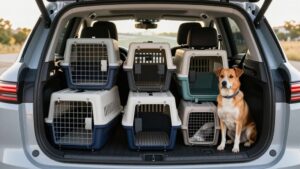
Although airline-style crates are built to withstand air-travel handling, that doesn’t show they can protect a dog in a car crash. CPS certification evaluates your crate and vehicle tie-down system in a simulated 30 mph impact. It checks containment, structural integrity, door and lock function, and whether connection points stay secured.
| Purpose | What it shows | What to check |
|---|---|---|
| Air-travel handling | Resists handling | Not crash proof |
| CPS crash test | 30 mph sled test | Independent rating |
| Tie-downs | Stay secured | Vehicle connection points |
Choose CPS’s independent sled-test rating, not an unsupported “crash-tested” claim; the CPS Certified logo identifies qualifying products.
Before you buy, verify the model and installation instructions; airline approval alone doesn’t establish automotive protection, and a shell can fail if its anchors release.
Emergency Escape Hatches
An emergency escape hatch can help you reach your dog after a crash, but it must not weaken containment during impact.
CPS-certified crates are designed to keep your dog inside during a 30 mph frontal collision, and testing checks that the door and locks still work and the dog isn’t ejected under crash G-forces. If your crate has a hatch, treat it as an access feature—not a substitute for verified crash performance.
After an impact, it may let you reach your dog sooner, while containment can help prevent a dog from running into traffic or creating a hazard. Choose a model whose hatch and door design matches the version CPS evaluated; a design change could affect the crate’s ability to hold your dog in a crash.
Skipping Crate Inspections
Even a CPS-certified crate can fail if you skip inspections. Check it regularly; certification doesn’t guarantee every component stays sound.
- Examine D-rings, tie-down pins, rivets, stainless parts, and skid-resistant feet for looseness, deformation, wear, or damage. Replace or repair anything suspect before driving.
- Test the door latch and locks; CPS evaluations assess structural integrity and continued function. Don’t drive with a sticking latch or popped rivets.
- Inspect straps and metal hardware before every trip. Use ratchet straps with adequate working load limit (WLL), secured to factory vehicle D-rings, not aftermarket hooks or seat-belt anchors.
- Check that the crate stays firmly anchored. In a 30-mph crash, forces can reach 20–25×; unchecked slack lets the crate move and increases impact loads on your dog. Make inspections routine.
Measure Your Dog and Vehicle
Before choosing a crate, measure your dog’s height from nose to floor, length from nose to tail base, and weight. Choose a fit with no more than about 2–4 inches of clearance so your dog can’t build momentum before contacting the front wall.
Next, measure the crate’s base and height against your vehicle. Its footprint must fit forward-facing with tie-down points aligned to factory D-rings. Check for suitable anchors near the seat floor or back; CPS-rated use depends on secure connections there.
Match crate height to the seat/back area so it stays within the vehicle’s boundary and top-mounted straps can route correctly. Plan for two to four ratchet straps and measure their reach. Tighten them until the crate won’t move when you push it firmly.
Conclusion
Choose a crash-tested dog crate with CPS certification, but don’t treat the label as a guarantee of safety. Anchor it to your vehicle’s recommended points, confirm the fit for your dog and car, and follow the manufacturer’s instructions.
Airline approval doesn’t prove crash protection, and material alone can’t tell you how a crate will perform. Inspect the crate, anchors, and escape hatch regularly. If anything’s damaged or loose, replace or repair it before your next drive.