What Size Dog Box Fits a Truck Bed? Fit Guide for Short and Long Beds
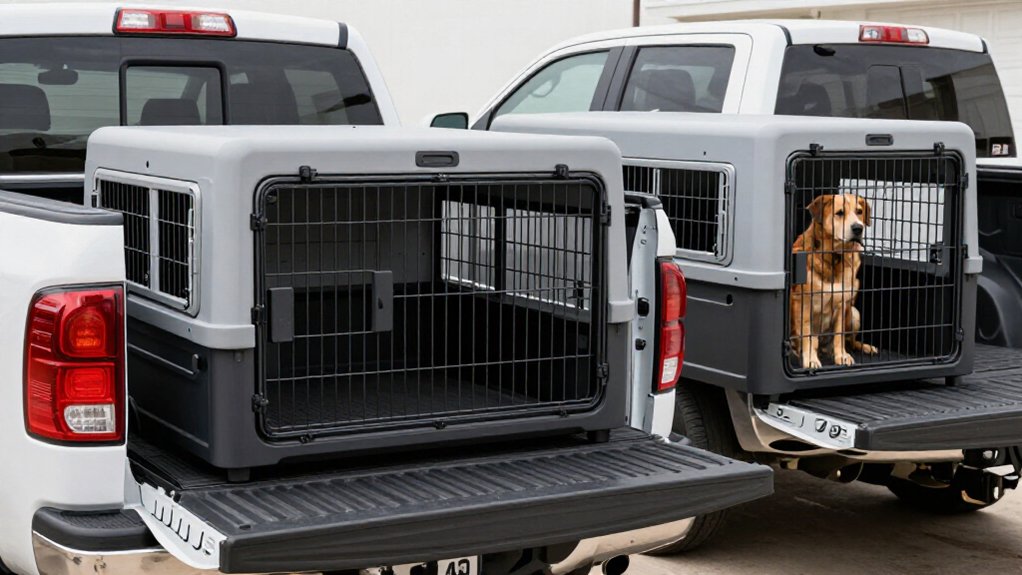
Choose a dog box by comparing its full exterior depth and width with your truck bed’s usable dimensions, not just the floor footprint.
A 5.5-foot short bed usually suits boxes up to about 42 inches deep; a 6.5-foot bed can fit roughly 48 inches, while an 8-foot bed offers more layout options. Measure between wheel wells and allow for liners, doors, and tailgate clearance.
Check that each dog fits its compartment comfortably. The guide below covers key measurements and secure installation.
Short-Bed Fit Considerations
A 5.5-foot short bed typically calls for a dog box no deeper than about 42 inches, but measure the bed’s interior length and check tailgate clearance before buying.
Measure the clear width between the wheel wells, not the bed’s advertised full width. A liner can reduce usable space, so account for its thickness before selecting a box. Side-by-side double boxes generally suit short beds better than front-to-back layouts, which need more length. Still, verify each box’s footprint against your actual bed dimensions.
Check wheel-well notches and compartment dimensions, too; a box may clear the wells yet leave too little room for your dogs. Some Owens Hunter Triple models include notches designed for short-bed compatibility. A 48-inch-wide model, such as the UWS DB-4848, needs 48 inches of unobstructed width.
Confirm that clearance around both wheel wells and any liner before ordering. Confirm the fit with the tailgate closed, not just open.
Truck Bed Length Compatibility Chart
Use this chart as a starting point for matching dog-box depth to truck-bed length: a 5.5-foot short bed generally suits boxes up to about 42 inches deep, while a 6.5-foot standard bed can fit boxes up to about 48 inches deep.
| Bed length | Suggested box fit |
|---|---|
| 5.5-foot short bed | Up to 42 inches deep |
| 6.5-foot standard bed | Up to 48 inches deep |
| 8-foot long bed | Full double box may fit beside a toolbox |
Before ordering, measure usable bed length and clear width between wheel wells, then compare both with the box’s exterior dimensions. Your bed liner and wheel wells can reduce usable space. Side-by-side double-dog boxes usually suit short beds better; front-to-back layouts need more length. On an 8-foot bed, toolbox placement depends on the box’s dimensions.
Tailgate Clearance Requirements
Measure usable bed depth from the cab bulkhead to the closed tailgate, then compare it with the dog box’s exterior depth.
For a 5.5-foot short bed, many boxes measure 36–42 inches deep. Check that the box and its door leave room for the tailgate to close. A 6.5-foot standard bed may accommodate a box up to 48 inches deep, but verify clearance at the tailgate hinge and allow for a bed liner. Measure with the liner installed, since it can reduce usable depth.
Your box layout affects length. Front-to-back double boxes need more length than side-by-side layouts, which suit short beds better. Before securing the box, position it and test the tailgate in open and closed positions. Confirm it won’t block closure or interfere with access.
Wheel-Well Clearance Measurements
Measure the bed’s clear width between the wheel wells, then compare it with your dog box’s base width—not the full rail-to-rail measurement. Account for wheel-well height, bed-liner thickness, and bedside clearance, and check that any notches align with the arches. Confirm the box won’t block tailgate access, and measure usable bed length behind the cab to the tailgate hinge.
Measure Between Wheel Wells
Will the dog box fit between your truck’s wheel wells?
Measure the bed’s clear width at its narrowest point between the wheel wells; don’t rely on the full rail-to-rail measurement. Compare that clearance with the dog box’s stated exterior width. A 48-inch-wide box needs at least 48 inches of unobstructed space. If you have a bed liner, measure with it installed because it can reduce the opening.
Also note how far the wheel wells protrude and their height. Those dimensions can affect whether the box sits flat and securely. If the box has side vents, check that the arches or other bed features won’t block airflow. Truck bed layouts vary by make and model, so verify the box dimensions and your measurements before ordering.
Check Box Base Width
Before buying a dog box, check that its base fits between your truck’s wheel wells. Measure the bed’s clear width at its narrowest point, rather than relying on rail-to-rail dimensions, which can overstate usable space. Compare this measurement with the box’s base width: a 48-inch base requires at least 48 inches of clearance.
Include your bed liner when measuring; its thickness can shrink the opening enough to make a close-fitting box too wide. Check the manufacturer’s dimensions for any wheel-well notches, including their width and position. Some Owens Hunter Triple models have notches designed for short-bed fit.
Confirm the base can rest securely without contacting or obstructing the wheel wells. Leave enough room to maneuver box into place and attach tie-downs without forcing the fit.
Account for Wheel-Well Height
If the box sits on the bed floor or has wheel-well notches, record each wheel well’s height and how far it protrudes into the bed. Measure the clear width between the wells, not the rail-to-rail span, and compare it with the box’s exterior width. A box that clears the rails can strike a wheel well or sit unevenly if its base overlaps one.
Include bed-liner thickness and rail or track accessories when judging clearance; each can reduce the space. On a short bed, check this width alongside bed depth: some boxes are 36–42 inches deep, while a 48-inch box needs at least 48 inches of width. Owens Hunter Triple models include wheel-well notches for short-bed fit, but verify the model dimensions against your truck.
Note Bedside Clearance
To check bedside clearance, measure the unobstructed width between the wheel wells and compare it with the dog box’s exterior width—not the bed’s full rail-to-rail span. Include each wheel well’s height and how far it protrudes, since either can limit where the box sits or how much of the bed it occupies. Measure with your bed liner and rail protectors installed; both reduce usable space. A box listed as 48 inches wide needs at least 48 inches of unobstructed clearance, with no allowance for those obstructions.
Check the box’s underside for wheel-well notches or cutouts. Some Owens Hunter Triple models include notches designed for short-bed compatibility. Measure bed depth separately, too: width clearance alone doesn’t confirm the box will fit behind the cab.
Verify Tailgate Access
Will the tailgate open and close freely once the dog box is in place? Measure your usable bed floor from the cab bulkhead to the tailgate hinge, then confirm the box leaves enough room for tailgate movement. Measure width between wheel wells, including bed-liner thickness; a box advertised as 48 inches wide needs at least 48 inches of unobstructed clearance.
Compare the box’s width, height, and wheel-well notch positions with your truck’s wheel wells. Some Owens Hunter Triple models include notches for short-bed fit. For a 5.5-foot short bed, use a box no deeper than 42 inches; a 6.5-foot standard bed may fit one up to 48 inches deep. Still verify your truck’s tailgate clearance. Before ordering, compare dimensions and confirm the tailgate and box doors move without contact.
Measure Before Ordering
Before ordering, measure the bed’s interior length from the cab bulkhead to the tailgate hinge and its clear width between the wheel wells. Also check wheel-well height and protrusion, plus any space taken by a bed liner, rail protectors, or tie-down tracks. Confirm the box won’t interfere with the tailgate’s clearance.
Compare your usable measurements with the box’s exterior dimensions: a 48-inch-wide box needs at least 48 inches of clear width. Check bed depth carefully, especially in a short bed. Many boxes designed for 5.5-foot beds are 36–42 inches deep; a 6.5-foot standard bed may fit one up to 48 inches deep.
Measure each dog, too. Add about 6 inches to nose-to-tail-base length and 4 inches to shoulder height to estimate minimum compartment dimensions. Verify the manufacturer’s dimensions before ordering.
Tailgate-Down Transport Limits
Once the box fits your measurements, check how it sits with the tailgate down. Measure usable bed length with the tailgate closed; lowering it doesn’t make an oversized box safe to haul. Secure the box to solid bed anchors, and keep its weight centered or mostly forward of the rear axle.
Don’t rest the load on an unsupported tailgate. Check that the box can’t shift or block your lights, license plate, or safe tailgate operation. If it extends beyond the bed, verify local overhang and marking rules, and use a properly rated support. Otherwise, choose a shorter box. Before every trip, recheck tie-downs; road vibration can loosen straps during travel. Don’t count the tailgate as usable bed length without verified support and proper legal clearance.
Two-Dog Box Fit Examples
A side-by-side double box can fit a 5.5-foot short bed better than a front-to-back layout, which needs more length. Before selecting a 48 × 48-inch model, confirm at least 48 inches of clear bed width between the wheel arches, accounting for your bed liner.
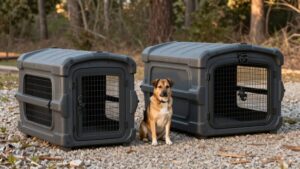
The UWS DB-4848, for example, has two separate compartments listed at 16 cubic feet each and is designed for two dogs. In a 6.5-foot standard bed, you can accommodate a box up to 48 inches deep; an 8-foot bed can hold a full double box plus a toolbox. Don’t choose by exterior dimensions alone: measure each dog’s length and shoulder height, then verify its compartment, typically 18–24 inches wide, lets it stand and stretch comfortably. Check each dog’s fit individually before you commit to that specific compartment.
Cab-to-Bed Clearance Checks
Even if a two-dog box fits the bed’s width, check its depth against the usable space from the cab bulkhead to the tailgate hinge. Measure usable length before ordering, then compare the box’s full external depth, not just its floor footprint, with that space. A short-bed box often measures 36–42 inches deep; a standard 6.5-foot bed may accept one up to 48 inches deep. Check liner thickness and cab-side contours; they can steal room.
Allow room for doors and handles to open, plus clearance around cab or bed accessories. Before you commit, confirm the box won’t strike the cab or tailgate and can sit securely in its intended position.
- Protect your dogs from cramped access.
- Avoid costly surprises.
- Load with confidence.
Factory Tie-Down Anchor Alignment
Check whether the box’s D-rings, welded rail, or mounting flanges line up with your truck’s factory bed anchors before you buy. Anchor the box at multiple points, ideally all four corners, using ratchet straps or compatible hardware to limit movement during hard stops. Check the bed itself; anchor locations vary, so don’t trust the truck’s model name or bed length. Make sure each strap reaches without crossing vents, doors, or access panels.
- A secure fit helps protect your dog when you brake suddenly.
- Clear access means you won’t fight straps at feeding or cleanup time.
- For permanent mounting, use compatible bed or stake-pocket points; follow the maker’s hardware and torque instructions.
Test the setup by checking every connection before loading your dog for travel.
Conclusion
Before ordering, measure your truck bed’s usable length, width between wheel wells, and cab clearance, then compare those dimensions with the dog box, not just the advertised bed size. Check tailgate clearance and tie-down anchor locations, especially if you plan to carry the box with the tailgate down. For two-dog boxes, confirm each compartment fits your dogs comfortably. When measurements fall close, choose a smaller box or verify fit with the manufacturer before you buy.
Dog Gate Opening Calculator with Extension Finder
Enter your opening width to see which dog gates cover it as stated, how many inches of extension you need, and how many extension kits that takes.