Are Dog Crates Safe in Cars? What Crash Tests Actually Show
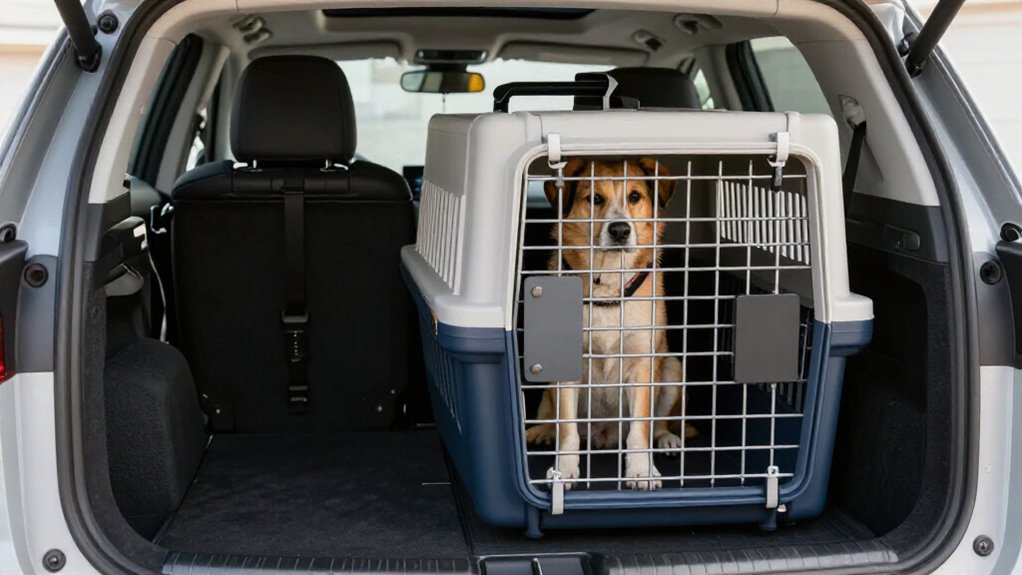
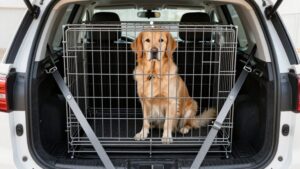
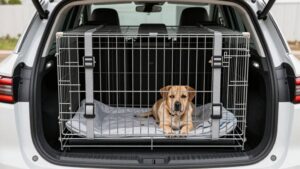
A dog crate can improve car safety, but only when you choose a suitable size, secure it correctly, and verify its crash-test evidence.
“Crash-tested” alone doesn’t tell you which impacts were evaluated. ISO 27955 uses defined conditions, test-dummy masses, and criteria for structural failure and harmful movement, making results more comparable; but a pass doesn’t guarantee protection in every crash direction or severity.
Strong, snug tie-downs matter; the details below explain what to check first.
Crash-Test Claims Explained
“Crash tested” isn’t a universal legal requirement for pet crates, so the phrase alone tells you little about a crate’s safety.
Look for the named test program and its documented results; vague marketing language doesn’t establish performance. Credible evidence comes from independent, accredited laboratories using controlled procedures, rather than manufacturer evaluations alone.
A single frontal impact isn’t enough: a crate may perform differently in rear-end impact or rollover conditions. Confirm test speed, applied forces, assumed dog or dummy mass, acceptance criteria, and whether the crate’s connections and anchors were evaluated.
Historical crashworthiness research has documented complete structural failures in some crate and carrier designs. So you should treat “crash rated” as a claim to verify, not a guarantee of protection. Ask for reports identifying tested configuration and limitations before relying on the label.
Proper restraint and vehicle fit also affect system behavior in a collision.
ISO 27955 Explained
ISO 27955 specifies how to test vehicle pet carriers and crates, including impact conditions, test-dummy mass, measurement methods, and criteria for evaluating structural failure and harmful displacement. The standard uses test dummies to assess crate performance under defined impacts. These controls let you compare results across products instead of trusting a vague “crash-tested” claim.
When a manufacturer says a crate meets ISO 27955, look for the standard and the scenario or scenarios tested; the label alone doesn’t tell you what happened in the test. A passing result supports protection only within its stated testing scope. It can’t establish how the crate will perform in every collision, because crash direction and severity vary. Treat compliance as useful, bounded evidence—not a guarantee of safety in all crashes.
Secure Tie-Down Straps
Even a crate that performs well in a defined crash test can fail if its restraints let it move.
Use strength-rated tie-down straps at designated anchor points; crash forces can be extreme, and connections are common failure risks in testing. Center for Pet Safety studies emphasize secure connections. Don’t use elastic or rubber bungee-style straps: they stretch during impact and may reduce the restraint forces that prevent crate movement. Tighten straps until you can’t noticeably shift the crate before driving; even partial movement can permit forward projectile motion in a collision.
| Check | Why it matters |
|---|---|
| Use multiple straps | CPS 2015 top results controlled motion better |
| Match tested layout | Performance assumes specified crate-and-strap setup |
Confirm fit before travel; don’t assume every strap suits every crate model.
Crumple Zones and Deformation
Your vehicle’s crumple zones absorb crash energy, so your crate must accommodate controlled deformation rather than resist it rigidly. In a rear impact, cargo-area deformation can push a crate into the rear seats; engineered telescopic compression can limit that movement and help protect your dog’s space.
Check whether crash tests show the crate deforms without failing or transferring excessive force to its mounts.
Controlled Impact Absorption
Because a vehicle’s crumple zones absorb collision energy through controlled deformation, a crate’s response to impact matters too. In a rear-end collision, cargo-area compression can drive a rigid crate forward toward the rear seats. If the crate can’t manage that loading direction, it may move dangerously or fail structurally, transferring force into the seating area.
Some engineered crates use telescopic-style compression to deform in a controlled way, limiting forward travel and aiming to reduce rear-seat back push-forward. The crate must also remain structurally retained as it deforms; otherwise, containment may be lost while the vehicle’s rear structure collapses.
When you assess crash-test claims, check whether testing measures controlled deformation, not containment alone. Energy absorption varies across frontal, rear, and rollover load paths, so one test direction can’t establish performance in another. Look for results specific to the impacts you’re evaluating.
Protecting the Dog’s Space
Vehicle crumple zones deform in a controlled way to absorb crash energy, but a rigid crate that can’t manage that deformation may redirect force toward the dog.
In a rear-end collision, cargo-area compression can drive a crate forward against the seatbacks. If the crate simply holds its shape, it may transfer concentrated loads into the dog’s occupied space or push that space toward the passenger compartment.
You should assess whether a system controls this movement, not just whether its shell stays intact. Engineered designs may use telescopic compression to limit forward travel as the cargo area deforms, while keeping the dog contained. That distinction matters because impact direction changes the dominant hazard: a crate optimized for one crash mode may offer less protection when rear-impact cargo movement governs.
Check crash-test evidence for measured intrusion and restraint of the crate’s position; appearance or rigidity alone can’t establish that your dog’s space remains protected.
Deformation Without Failure
Protecting a dog’s space also depends on how a crate deforms under impact: properly tested designs can crumple in a controlled way to absorb energy while keeping the dog contained and the anchors intact.
Your vehicle’s crumple zones compress in sequence; if your crate ignores them, it may strike the rear seat or redirect forces. Rear impacts compress cargo space, driving rigid crates forward. Telescopic designs limit intrusion. The goal isn’t an undeformed box: deformation without failure means the shell changes shape while containment and anchors stay intact, preventing your dog from becoming a projectile. Check the standard, such as ISO 27955, and review evidence of structural integrity and containment.
| Impact | Design response | Safety check |
|---|---|---|
| Front | Controlled crumpling | Containment |
| Rear | Telescopic travel | Anchors |
Dog Size and Crate Fit
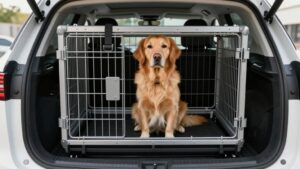
Choose a crate about 6 inches (15 cm) longer than your dog’s body, with enough room to stand, turn, and lie down comfortably. Avoid excess clearance: a crate that’s too large lets your dog surge forward during a collision, increasing impact risk.
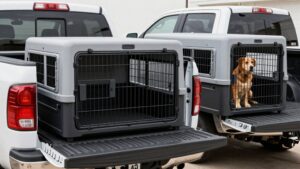
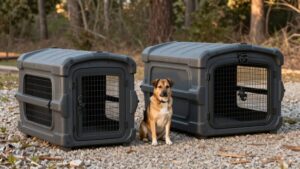
In a two-crate setup, check that each crate fits the vehicle width and supports your dog without gaps that allow shifting.
Match Crate to Dog
For a safer fit, measure your dog’s current weight, height, and body length from nose to tail base, then look for a crate generally about 6 inches longer than the body. Use the manufacturer’s weight and height category, not breed labels alone: an undersized shell may compress against your dog under crash loading, while an oversized one can shift and increase forces.
Compare internal dimensions and door opening with your dog’s measurements; external dimensions don’t establish usable space. In a vehicle, secure the crate so it moves minimally side-to-side and front-to-back, reducing the chance your dog will strike its door or walls. For two-dog or side-by-side layouts, check each crate’s width and dimensions; neither dog should be cornered against components that could bear loads.
Allow Room to Move
A crash-tested crate still needs to fit your dog: it should let them stand and turn comfortably, with an interior roughly 6 inches (15 cm) longer than their body. That clearance helps your dog maintain a natural posture rather than forcing them tight or folded.
In a crash, a too-small enclosure can restrict normal bracing and positioning, increasing stress and the chance of contact with the crate’s walls or door. Measure usable interior dimensions, not external dimensions or the label, and account for the door opening and internal narrowing. This matters with tall or narrow models used side by side in vehicles.
Check that each crate fits its planned position without crowding seats or neighboring crates; placement can affect how it sits in the tested geometry. Proper fit supports safer positioning, but it doesn’t replace secure installation or a crash-tested design.
Avoid Excess Space
During sudden braking or a collision, excess room can let your dog slide or strike the crate walls. Choose a crate that fits your dog closely; many crash-safety recommendations allow about six inches (15 cm) beyond your dog’s body length. This limits sliding without preventing movement.
You should see your dog sit, stand, and turn comfortably while limiting side-to-side travel. Avoid extra length, height, or width: a roomy carrier lets your dog shift and increases the chance of impact with its walls. Uncontrolled movement within the crate is a concern during crash forces.
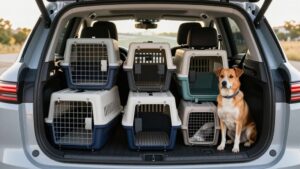
With a Variocage or custom-fit design, fit the crate tightly to your vehicle’s interior to reduce relative movement. If you’re installing two crates side by side in an SUV, prioritize correct sizing for each dog over oversized “just in case” crates; extra space can undermine protection.
Emergency Escape Hatch Access
If a crash jams the main door, can you reach your dog quickly?
An emergency escape hatch gives you an alternate exit when the primary door is jammed or inaccessible. Before buying a crate, check that you can open the hatch from outside without special tools. Assess whether collision damage or crate deformation could block it; a hatch is useful only if you can reach and operate it under conditions.
Position and secure the crate so you can access this exit quickly without first removing a crate, particularly if damage restricts access to its front. Check tie-down straps won’t obstruct the hatch, and confirm you can release them fast enough in an emergency. Verify that hatch operation doesn’t weaken the crate during normal driving.
Rear-End Collision Performance
Access to an escape hatch matters after a crash, but the crate must also protect your dog during the impact itself.
Rear-end collisions are the most common crash type, so you should check whether a crate’s design addresses forward kick and cargo-area compression. In many impacts, the crate or cargo barrier can move forward into the rear seats; without managed deformation, it may transfer substantial force to your dog.
ISO 27955 evaluates structural performance under defined impact scenarios, but a frontal test alone doesn’t establish rear-end protection. When you see “crash tested,” verify the standard and included impact types; limited testing may not predict rear-end behavior. A properly crash-rated crate uses controlled crumple features to reduce ejection risk and high loads on your dog.
Loose Objects Become Projectiles
In a crash, inertia can turn an unsecured crate, dog, or loose bedding into a projectile. Your vehicle may slow, but its contents keep moving at the prior speed. At about 50 km/h, an unrestrained 30 kg dog can generate forces comparable to 750 kg; loose cargo adds momentum.
- A containment-only crate may shift or break apart because it isn’t anchored for impact.
- In a rear-end collision, cargo-area compression can drive loose items toward rear-seat occupants or your dog.
- Use a properly crash-tested crate and strength-rated tie-down straps; don’t rely on elastic cords or bungees.
These controls reduce movement but don’t make every setup equally protective.
Secure bedding and other cargo separately so they can’t become secondary impact hazards during sudden vehicle deceleration.
Pack a Pet First-Aid Kit
After a crash, a stocked pet first-aid kit lets you address minor injuries while arranging veterinary care. Pack styptic powder or a pen, gauze rolls, self-adherent wrap, non-stick pads, antiseptic wipes, and saline rinse to control bleeding and clean wounds. Add a digital thermometer, muzzle, and emergency blanket or towel to monitor temperature, prevent bites, and limit heat loss in transit.
Include tweezers or a tick tool, an instant cold pack, and cotton swabs for punctures or lacerations. Bring your dog’s medical information, vet contacts, and medications with instructions; stress can make dosing hard to recall during an emergency call. Store supplies in a waterproof pouch in your car. Check expiration dates, particularly for antiseptics and single-use items, so your kit’s ready when seconds matter.
Conclusion
Treat a car crate as safe only if its installation and tested performance support that claim. Don’t rely on marketing: check relevant crash-test criteria, including ISO 27955, and secure the crate to approved vehicle anchors with suitable straps. Allow for deformation, choose a crate that fits your dog, and keep emergency access clear.
Restrain loose objects; they can become projectiles. Carry a pet first-aid kit, but remember it can’t replace proper crash protection.