Soft Crate vs Wire Crate: Portability, Chew-Proofing and Everyday Use
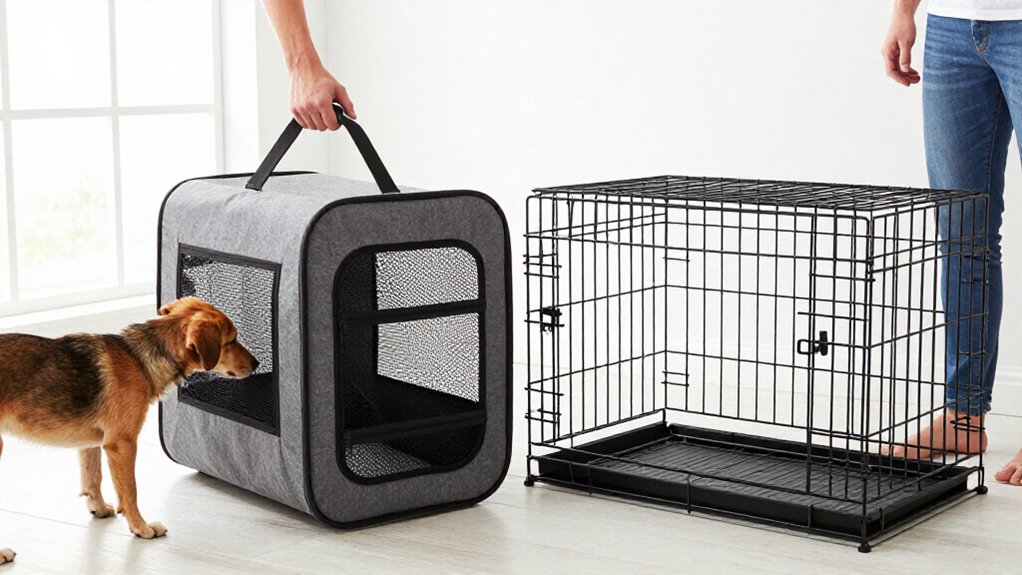
Choose a soft crate if you need lighter carrying and compact storage; they fold flat, but fabric and mesh can tear if your dog chews or scratches.
A sturdy wire crate weighs more, yet offers better resistance, airflow, and visibility for everyday use. Check that your dog can stand, turn, and lie down comfortably, and inspect doors and seams.
For car travel, use a travel-designed crate secured as instructed. You’ll find more practical guidance below.
Portability, Chew-Proofing, and Daily Use
If you need a crate that’s easy to carry or store, a soft crate is lighter and folds flatter than a comparable wire crate. That makes it convenient for trips, small homes, or occasional outings. Choose it for a reliably crate-trained dog; soft fabric can be damaged if your pet claws or bites it. Wire suits daily confinement and puppy training better, though it may rattle on hard floors; a mat can soften the noise.
| Your situation | Practical pick | Why |
|---|---|---|
| Travel or storage | Soft | Light, folds flat |
| Puppy or chewing | Wire | Sturdier, often has divider |
For either crate, choose a size that lets your dog stand, turn around, and lie down comfortably. Place it where daily use stays calm and practical for both of you.
Frame and Fabric Construction
Beyond portability, construction affects how a crate holds up to daily use. Soft crates pair fabric covers with collapsible frames, so you can fold them for storage. Their design varies: some rely on internal steel tubes; others use flexible spine strips, zippers, or wire.
- Nylon or canvas paired with mesh keeps the crate light and lets air circulate.
- Removable covers can go in the wash, making routine cleanup easier.
- Wire crates expose an open metal frame, giving you airflow and clear sightlines.
- Plastic crates use hard, enclosed sides with ventilation slits; you get less visual openness.
When you compare models, check reinforced seams and rounded corners, which vary by design. Choose a layout you can clean and set up at home.
Performance Under Chewing and Scratching
When a dog chews or claws at its crate, a soft model’s fabric, mesh, seams, or zippers can tear, creating an escape risk.
If your dog gets excited or frustrated, persistent chewing or scratching may damage even sturdy mesh. The Midwest Canine Camper had thicker, rubberized door and window panels than other tested soft crates, but no soft mesh is guaranteed to resist ongoing clawing.
Reserve soft crates for reliably crate-trained dogs that don’t chew or claw; they’re not a sound choice for puppies or dogs prone to chewing. If your dog targets fabric, a wire crate is more suitable, though you shouldn’t assume any crate is completely chew-proof. Inspect fabric, mesh, zippers, and the frame regularly, and supervise your dog if escape attempts arise.
Setup and Fold-Down Speed
Most soft crates with internal frames set up and fold down in seconds, often without tools. That speed helps when you move crates or need to reclaim floor space. Check folding steps before buying; some designs take longer, especially during busy daily routines.
- Elite Fields’ Three-Door Folding Soft Crate uses a lightweight steel-tube frame; fold it into itself and secure it with two quick-release buckles.
- The Firstrax Noz2Noz Sof-Krate sets up in seconds; a sleeve secures its frame, and it folds for carrying.
- The Firstrax Petnation Port-a-Crate E-Series has a lightweight internal frame for setup and takedown in seconds.
- By contrast, the Go Pet Club model uses zippers and flexible spine strips, while Precision Pets requires several steps to position and lock its crossbars.
Ventilation and Visibility
Setup speed matters, but your dog’s comfort also depends on how much they can see and how well air circulates. Wire crates offer open-frame visibility and airflow, which can suit a dog who settles better when they can watch their surroundings. Soft crates rely on mesh panels; more mesh means more ventilation. The Elite Fields Three-Door Folding Soft Crate has extensive mesh, making it an option in warmer climates.
Fabric panels can create a more private, den-like space. If your dog gets overstimulated by activity, roll-down curtains on models let you cover mesh doors or windows as needed. Check opening size: the Firstrax Petnation Port-a-Crate E-Series has small bone-shaped windows, so it provides less ventilation than models with larger mesh openings.
Cleaning Fabric After Accidents
After an accident, a removable, washable cover can make a soft crate easier to clean. Follow the manufacturer’s laundering instructions; using the recommended method helps protect the fabric while removing mess.
- Take off the cover and wash it as directed; avoid shortcuts that conflict with its care label.
- With the cover off, wipe the frame using a damp cloth, then let both parts dry fully before reassembling.
- Place a washable mat or bedding inside to catch messes and simplify routine cleanup.
- Check seams and mesh for damage while cleaning; chewing or scratching can weaken fabric.
If accidents happen often, check whether your dog has enough room to stand, turn, and lie comfortably, and offer more frequent bathroom breaks. Respond calmly; accidents can signal unmet needs.
Escape Risks During Unsupervised Use
When you leave a dog crated unsupervised, choose a crate that matches its behavior and escape risk.
Soft crates aren’t suitable for puppies or dogs that aren’t reliably crate-trained: chewing, clawing, or frustration can damage fabric, mesh, and zippers, creating an escape route. Even a well-trained dog may get out when excited or frustrated. Some models use zipper-lock clips, but others have zippers that don’t lock, so check how the closure secures before leaving your dog inside.
Inspect doors, seams, and the frame for damage that could widen into an exit; choose a sturdier wire crate for a dog who chews or scratches. Still, no crate replaces appropriate supervision and training. Your dog must be able to stand, turn around, and lie down comfortably inside the crate.
Soft Crate vs Wire Crate Pros and Cons
When you compare portability and setup, a soft crate is lighter, folds flatter, and can be ready in seconds. A wire crate takes more effort to carry, but its sturdier build better resists chewing and clawing. Choose based on your dog’s habits and how often you’ll move or store the crate.
Portability and Setup
For travel and temporary use, soft crates are usually lighter, fold flatter, and take less effort to carry and store than wire crates. That can make them easier to manage when you’re setting up a temporary resting place or packing a small vehicle. Still, compare the opening and folding steps; designs differ.
- A framed 36-inch Elite Fields model weighs 14 pounds, folds into itself, and assembles in seconds without tools.
- A frame-free SportPet Pop Crate weighs 6.35 pounds in large size, but folding it takes a 180-degree twist.
- Collapsible wire models fold flat, though their extra weight can make carrying harder.
- Check how quickly you can open and fold a crate, how you’ll carry it, and whether its packed size fits your storage space.
Durability and Chew Resistance
Soft crates offer convenience, but their canvas and mesh can tear when a dog chews or claws at them, giving an excited or frustrated dog a chance to escape. They’re best for dogs who are reliably crate-trained, not puppies or persistent chewers. If your dog tends to test boundaries, a sturdier wire crate is usually the more practical choice.
Wire models generally resist damage better than fabric crates, but they aren’t chew-proof. Check yours regularly for sharp edges or protruding parts that could injure your dog. On soft crates, inspect zippers before each use: some lack zipper locks, while others include clips to help keep doors shut. In testing, the Midwest Canine Camper had the sturdiest mesh, with thicker rubberized door and window panels designed to better withstand clawing. Choose based on your dog’s behavior, not appearance alone.
Post-Surgery Recovery Crating
After surgery, choose a crate where your dog can stand, turn, and lie down comfortably while following your vet’s activity limits. Consider whether your dog stays calmer in a visible wire crate or a more enclosed plastic one; use a soft crate only if your dog won’t chew, claw, or push at it. Set up washable bedding in a quiet spot, check for distress or damage, and use a vet-approved restraint or secure travel crate for car trips.
Recovery Crate Safety
When your dog needs post-surgery confinement, use a crate only if your veterinarian recommends it and approves its type and size for the procedure. Make sure your dog can stand, turn, and lie comfortably; restrict extra room only when your vet directs it.
- Assemble the crate securely and remove hazards, including sharp edges or protruding parts.
- Supervise your dog to catch distress, damage, or escape attempts early.
- Follow your veterinarian’s schedule for confinement, exercise, bathroom breaks, and monitoring.
- Give care and breaks as directed; don’t leave your dog confined for prolonged periods.
If your dog chews, scratches, or panics in confinement, tell your veterinarian promptly. Fabric or mesh may tear, creating injury or escape risks. Crating should support healing, not replace attentive care.
Choosing Crate Type
Once your veterinarian approves confinement, choose a crate that limits movement without preventing your dog from standing, turning around, and lying down comfortably.
A wire crate can offer airflow and visibility; add a divider if needed to create a recovery space that fits your dog without excess room. A soft crate is lightweight and may feel more enclosed, but skip it if your dog might chew, claw, or push through mesh or zippers.
Choose based on your dog’s behavior and your veterinarian’s setup instructions, not convenience alone. Assemble either type securely and inspect it for sharp or protruding parts before confinement. Follow your veterinarian’s directions for how long your dog should stay crated, and provide regular, supervised bathroom breaks when your veterinarian recommends them.
Comfort During Healing
For comfortable healing, use a crate after surgery only if your veterinarian recommends confinement, and follow their guidance on activity restriction. Choose a crate that lets your dog stand, turn around, and lie down comfortably, but doesn’t leave excess room for movement.
A soft crate may work for a reliably crate-trained dog needing brief confinement; fabric can’t withstand chewing or scratching. If your dog may chew or escape, choose sturdy wire or plastic instead.
- Add washable mat or familiar bedding.
- Set crate in a quiet, low-traffic spot where you can monitor your dog.
- Check the crate after surgery for sharp edges or protruding parts.
- Offer regular bathroom breaks and check your dog; don’t leave them confined for extended periods.
Travel and Vehicle Safety
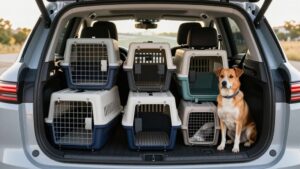
Although soft crates are lightweight and fold compactly, they aren’t recommended for car travel because crash forces could propel a dog through the mesh.
For vehicle trips, choose a crate designed for travel and secure it exactly as its manufacturer instructs. Straps marketed for soft crates don’t, by themselves, show that the crate can protect your dog in a crash. A plastic crate may suit travel and meet airline requirements, but airline approval doesn’t prove vehicle crash safety.
Before leaving, assemble the crate securely. Inspect mesh, zippers, edges, and protruding parts; repair or replace anything damaged that could let your dog escape or cause injury. Flying? Check your airline’s rules before booking: acceptance depends on the specific crate and carrier. Always follow restraint guidance carefully.
Conclusion
Choose the crate that fits your dog’s behavior, your routine, and the setting—not just the setup. A soft crate travels easily and feels sheltered, but it won’t withstand determined chewing or scratching. A wire crate offers stronger containment and airflow, though it’s heavier and can expose paws to hazards if designed poorly. For recovery or car travel, follow your veterinarian’s guidance and use a crash-tested restraint; neither crate makes a ride safe. Supervise, inspect, and adjust.