Impact vs Gunner Dog Crate: Strength, Weight, Travel Use and Price
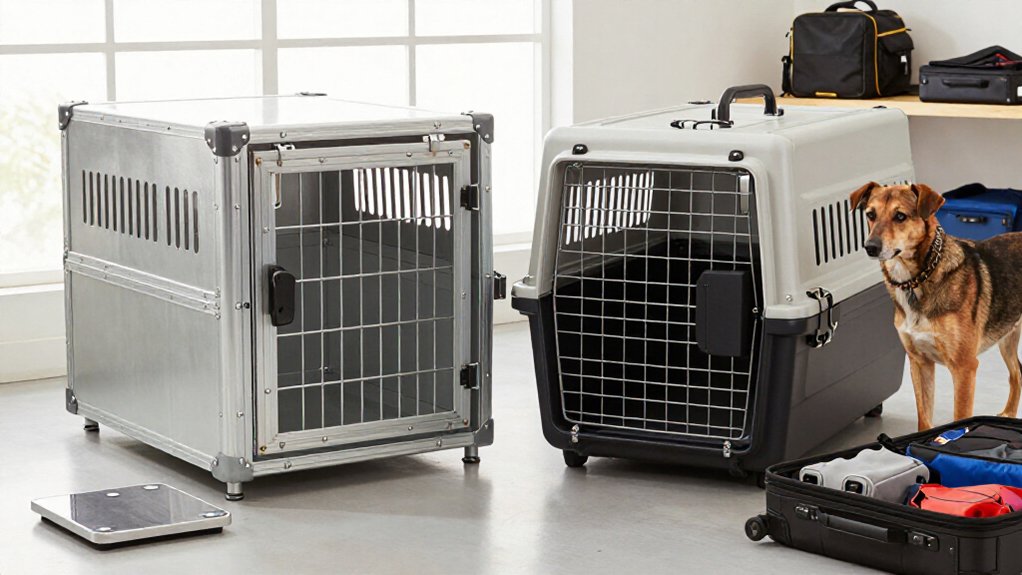
Choose Gunner if you prioritize crash protection: its Small, Medium, and Intermediate earn five-star CPS ratings when secured with tie-down straps. Impact uses aircraft-grade aluminum for high-drive chewers, but its crash testing lacks a supplied CPS rating.
Gunner’s Intermediate weighs 48 pounds and costs $700; its Small is $550 and Large $900. Impact’s price and weight aren’t supplied.
Measure your vehicle; compare fit, handling, ventilation, and temperament before choosing. The model details can help you decide.
Strength, Weight, and Price
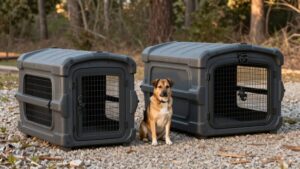
If you’re comparing strength, weight, and price, the main difference is construction: Gunner uses double-wall rotomolded plastic with a welded aluminum door frame, while Impact uses aircraft-grade aluminum and targets high-drive dogs and escape artists.
For your decision, compare verified safety evidence and published cost with strength claims; Impact’s exact weight and price aren’t provided.
| Brand | Strength evidence | Weight and price |
|---|---|---|
| Gunner | Five-star CPS ratings: Small, Medium, Intermediate | 48 lb Intermediate; $700 |
| Gunner sizes | Lifetime warranty; dog-caused damage excluded | $550 Small; $900 Large |
| Impact | Crash-tested; no specific rating supplied | Model figures unavailable |
| Everyday options | Both brands cost more than lighter crates | Compare budget and lifting needs |
Use the Intermediate figures as a concrete benchmark, not a direct weight comparison: Impact’s lighter-weight description lacks numbers. Choose based on your dog’s behavior, handling capacity, and whether documented ratings matter to you in practice.
Materials and Latch Design
Materials and latch design distinguish these crates: Impact uses aircraft-grade aluminum for strength and security, while Gunner pairs double-walled, roto-molded polyethylene with a custom-welded, powder-coated aluminum door frame.
You get distinct designs: Impact emphasizes a metal shell; Gunner combines a polymer body with a metal entry point. Gunner’s reversible paddle latch accepts a key lock, and safety latches at the top and bottom provide backup. Four built-in stainless-steel tie-down pins let you secure the kennel inside a vehicle. Impact also prioritizes secure latching, but the details don’t identify its latch mechanism, so you can’t compare hardware feature for feature.
If you need a keyed closure and secondary latches, Gunner states those features. With Impact, assess its heavy-duty construction and confirm latch details before buying.
Available Sizes and Dimensions
Gunner offers four G1 sizes, while the available information doesn’t specify Impact’s dimensions, so a size-by-size comparison isn’t possible. Gunner lists Small, Medium, Intermediate, and Large, with interior floor dimensions of 21.75 × 14.5 × 15.5, 25 × 18 × 19.75, 30 × 18 × 25, and 33.25 × 21 × 29 inches, respectively. Suggested weight ranges are up to 30, 45, and 70 pounds for three sizes, and 71 pounds or more for Large.
Check exterior footprint: exterior dimensions are 24.5 × 18.625 × 19, 29.5 × 20.5 × 23.5, 34 × 23 × 28.5, and 40.25 × 28 × 33.25 inches. Handles add up to 1.5 inches in height. Measure your dog and space; don’t infer Impact’s fit without its dimensions.
Door Access and Loading
How a crate opens can affect loading and emergency access. The Gunner G1 has one metal door with a reversible design, so you can set it to open from either side. Its paddle latch, key lock, and backup safety latches secure the entry; check each before travel.
Because the G1 has only one door, a blocked entrance could make reaching or removing your dog harder in an emergency. Consider whether you could clear access quickly and lift your dog out. Gunner’s optional Chew Kit adds steel covers for the door and windows, helping protect these areas from determined chewers. Impact describes its crates as airline-friendly, but available details don’t identify the door style or loading arrangement. Ask the manufacturer about entry configuration before choosing.
Vehicle Cargo-Area Fit
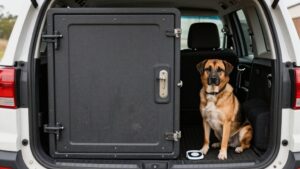
Once you’ve considered door access, check whether the crate will fit through your vehicle’s cargo opening and sit securely inside. Gunner’s G1 dimensions vary by size: Small measures 24.5 × 18.625 × 19 inches, while Large measures 40.25 × 28 × 33.25 inches. Handles add 1.5 inches to the height. The Intermediate model measures 34 × 23 × 28.5 inches externally, or 30 inches high with handles. Check your cargo opening and clearance before buying.
Gunner’s fit-finder factors in vehicle dimensions, and its gallery lets you filter examples by vehicle make and model. However, Gunner doesn’t guarantee fit based on measurements. One owner reports a G1 Medium fit in a 2012 Subaru Forester with seats folded or upright. Impact dimensions and fit data aren’t provided here, so compare the model’s exterior measurements with your cargo area before purchase.
Replacement Parts Availability
Replacement-part support can matter if a door, latch, handle, or tie-down fails. Gunner lists owner manuals and replacement accessories, including door covers, tie-down straps, handles, and kennel-specific components. Its lifetime warranty applies only to the original purchaser and excludes dog-caused damage, such as chewing, so don’t treat it as coverage for every failure.
Impact describes durable construction and security features, but its product details don’t identify available replacement parts or give parts prices. Before choosing either crate, contact the manufacturer to verify whether you can buy compatible doors, latches, handles, and hardware. Ask for current costs and ordering details, and confirm fit for your exact model. This helps you compare maintenance costs.
Crash-Test Certification Variations
Although both brands describe crash protection, their certification details differ. Gunner’s Small, Medium, and Intermediate kennels carry a five-star crash-test rating from the Center for Pet Safety (CPS). Gunner recommends its Tie-Down Strap Kit for five-star safety; you’ll need to purchase the straps separately, and they’re designed to anchor the kennel to your vehicle.
Impact Dog Crates are described as crash-tested, but the information doesn’t identify a certifying organization, rating, or certification details for individual models. That makes comparison difficult: you can verify a CPS rating for three Gunner sizes, while Impact’s claim lacks equivalent specifics. Before choosing, check whether the model you’re considering has documented test results, and confirm what anchoring equipment you need. Don’t assume a crash-tested claim equals a published rating.
Ventilation and Visibility
When comparing airflow, you’ll find that Impact’s aluminum construction allows more ventilation than Gunner’s insulated double walls. Gunner’s window vents and optional weatherproof Fan Kit 2.0 add airflow, but the walls may slow cooling from your vehicle’s air conditioning. Compare each crate’s openings and sightlines to see how well your dog can view its surroundings.
Airflow and Ventilation
Impact is described as offering stronger ventilation, which may suit dogs that need more air circulation. Available information doesn’t provide comparable vent dimensions or airflow measurements. You so can’t quantify how much more air Impact moves than Gunner, or assume a temperature difference inside either crate.
Gunner’s double-wall construction provides insulation, yet its walls limit airflow and can slow temperature changes when your vehicle’s heating or air conditioning is running. Window vents provide passive ventilation, while the optional Fan Kit 2.0 adds weatherproof, rust-proof airflow and runs for up to 20 hours.
Consider your dog’s heat tolerance, trip length, and vehicle climate when choosing. If you use Gunner, the fan may help when passive venting doesn’t meet your needs; check conditions during travel.
Visibility and Sightlines
Ventilation and visibility are separate considerations, and the available information doesn’t show how Impact and Gunner compare in window placement or how much dogs can see outside.
Gunner’s double-wall construction and window vents support insulation and airflow, while its optional Fan Kit 2.0 provides active ventilation for up to 20 hours. Thicker walls may restrict airflow compared with more open designs, so the fan and vents can help you manage conditions inside.
These ventilation claims don’t establish which crate offers a clearer view or how much visual stimulation your dog receives. If sightlines matter, check each model’s photos or specifications for vent locations, opening size, and whether a dog can see through them from a lying or standing position. Don’t assume airflow openings function as viewing windows; confirm visibility with the manufacturer before choosing.
Kennel Suitability by Dog Temperament
Your dog’s temperament helps determine whether a kennel suits calm, settled behavior or anxiety and escape attempts. For a strong, persistent chewer, compare Impact’s aluminum shell with Gunner’s reinforced door and optional steel Chew Kit. Whichever you choose, check that your dog can stand, turn around, and lie down comfortably, and pair the crate with training if confinement causes anxiety.
Calm and Settled Dogs
If your dog is calm, crate-trained, and free of anxiety issues, a lightweight Ruff Land may be sufficient for everyday containment and travel, but it isn’t crash-tested. For a settled dog, you may not need the weight and reinforced construction of an Impact or Gunner, but choose based on your use, not temperament alone. Measure your dog and confirm the kennel allows standing, turning around, and lying down comfortably.
If you drive with your dog, secure the crate rather than relying on a calm disposition. Gunner’s five-star CPS-rated sizes require the recommended tie-down straps to meet the certified safety setup. Impact and Gunner offer more robust designs, but that extra protection may not be necessary for containment. Check fit, compatibility, and handling needs before deciding.
Anxious or Escape-Prone Dogs
For an anxious dog that chews under stress, Gunner’s double-wall construction, escape-resistant door, and optional steel Chew Kit may offer a stronger containment setup. Your choice should reflect how your dog reacts when confined, not just the crate’s materials.
- If stress triggers chewing or escape attempts, Gunner’s design gives you added containment features.
- You can add the Chew Kit to cover its windows and door; it’s optional, not standard.
- Impact may suit a high-drive escape artist; its aircraft-grade aluminum construction emphasizes maximum security.
- Ruff Land may work for a crate-trained dog without anxiety, but plastic may be vulnerable to stress-related chewing.
No kennel guarantees escape prevention, so supervise your dog’s adjustment and reassess if distress or attempts continue before you rely on it unsupervised.
Strong, Persistent Chewers
Chewing that persists beyond stress-related episodes calls for a kennel built to resist damage. Impact Dog Crates use aircraft-grade aluminum designed for high-drive dogs and escape artists. If your dog persistently attacks kennel walls or corners, this metal construction is suited to heavy chewing. Inspect it regularly.
Gunner offers a sturdy alternative: its double-walled, roto-molded plastic shell pairs with an escape-resistant metal door and security latches. If your dog chews plastic, Gunner sells a $200 Chew Kit with powder-coated steel window and door covers. Factor that cost into your comparison. Gunner’s lifetime warranty excludes damage caused by the kennel’s inhabitant, so chewing damage isn’t covered.
Ruff Land may suit you less if your persistent chewer can bite through plastic, as anxious dogs may do. Compare the materials with your dog’s established habits and supervise early use.
Impact vs Gunner: Final Pick
Choose Gunner when documented car-crash protection matters most: its Small, Medium, and Intermediate crates have a 5-star Center for Pet Safety rating when secured with the required tie-down straps.
You’ll choose based on containment, travel, and budget:
- Pick Gunner if you want verified crash protection; its rating depends on using those straps correctly.
- Its Intermediate model weighs about 48 pounds and costs $700, so don’t treat it as a light or low-cost option.
- Choose Impact for aircraft-grade aluminum containment with an escape-prone dog; it’s described as crash-tested, but no comparable CPS rating is supplied.
- Some models collapse, and airline-oriented features may suit your trips, though Impact costs more and no price is specified.
Match your pick to the protection and handling you actually need.
Conclusion
Choose Impact if you prioritize lower weight, flexible loading, and a range of sizes; choose Gunner if you want a rugged, insulated kennel and its specific crash-test certification. Before buying, compare interior dimensions with your dog’s measurements, check door access and cargo-area fit, and confirm ventilation suits your climate. Match latch security to your dog’s behavior, too. Prices vary by size and configuration, so weigh the features you’ll use against the added cost, not just the brand name.